
What if you could build an application by describing what you want instead of writing thousands of lines of code?
That is the promise of vibe coding. With AI-powered coding tools such as Cursor, Claude Code, Lovable, Bolt, and Replit, developers and founders can turn natural-language instructions into working interfaces, APIs, database structures, and application features.
The approach is transforming software development. Startups can validate product ideas faster, developers can automate repetitive tasks, and small teams can experiment with applications that previously required significantly more engineering effort.
But there is a catch: software that works in a demonstration is not necessarily software that is ready for production.
An AI-generated application might look polished while containing insecure authentication, incorrect business logic, poorly structured databases, vulnerable dependencies, or integrations that fail under unexpected conditions. These problems can remain hidden until real users begin interacting with the application.
The scale of AI adoption makes this challenge increasingly important. According to Sonar’s 2026 State of Code Developer Survey, AI-generated or significantly assisted 42% of code contributed by surveyed developers. Yet only 48% said they always verified AI-generated code before committing it.
This gap between code generation and verification is creating a need for more structured software quality controls.
Enter vibe coding audits: a systematic way to evaluate AI-generated software before it reaches production.
In this guide, we explore what vibe coding audits involve, why they matter, the checks every audit should include, and how businesses can establish a repeatable quality gate without sacrificing the speed AI makes possible.
What Is a Vibe Coding Audit?
A vibe coding audit is a structured assessment of software built with AI coding assistants or autonomous coding agents. It evaluates whether the application is functionally correct, secure, maintainable, reliable, and suitable for its intended production environment.
Unlike a quick review of whether a generated interface looks right, an audit examines both the underlying implementation and the application’s actual behavior.
For example, imagine a startup uses an AI coding tool to create a subscription-based SaaS platform. The registration page works, users can sign in, and the dashboard displays the expected information.
However, a deeper review might reveal that users can access another customer’s records by changing a request parameter, subscription cancellations do not update billing correctly, and database queries become inefficient as records increase.
The application appears complete, but important production requirements remain unmet.
A vibe coding audit is designed to identify these gaps before they become security incidents, customer complaints, or expensive engineering problems.
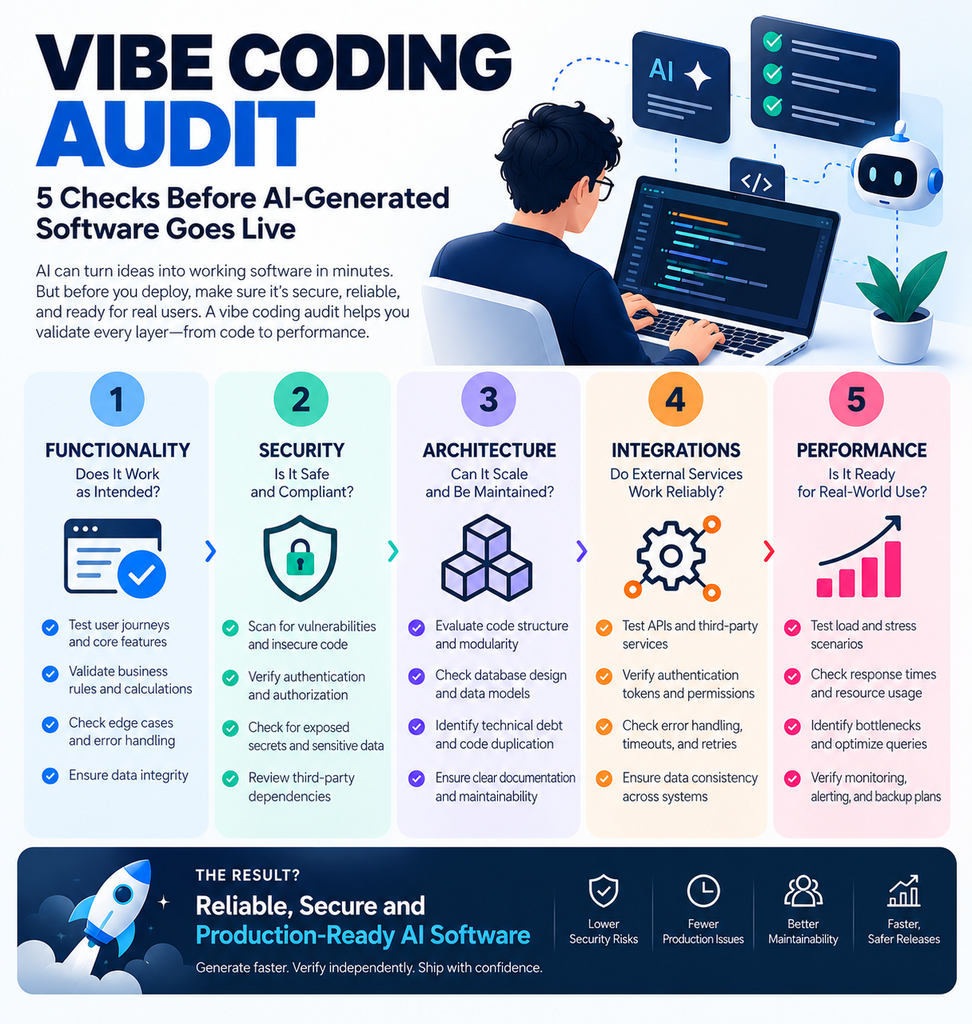
A typical audit evaluates five fundamental questions:
- Functionality: Does the software behave according to documented requirements?
- Security: Does it protect user data, credentials, and privileged operations?
- Architecture: Is the application structured appropriately for its intended use and expected growth?
- Maintainability: Can developers understand, test, and safely modify the code?
- Production readiness: Can the application handle realistic workloads, failures, deployments, and ongoing maintenance?
Vibe coding audits do not replace conventional software quality assurance. They apply established engineering practices to AI-assisted development, with particular attention to the risks created by generated code, rapid changes, and autonomous agents.
Why AI-Generated Software Needs a New Quality Gate
AI coding tools have made generating code faster, but generating more code does not automatically produce more reliable software.
The difference between development speed and software quality becomes clearer when we examine recent research.
What the research tells us
- 44% of tested AI code-generation tasks introduced security vulnerabilities.
Veracode’s 2026 GenAI Code Security Report found that approximately 44% of tested AI code-generation tasks produced code containing a known security vulnerability.
This result comes from controlled code-generation testing. It does not mean that 44% of all AI-built applications are vulnerable. It demonstrates why generated code should be independently evaluated rather than assumed secure.
- 42% of contributed code was AI-generated or significantly AI-assisted.
Sonar’s 2026 developer survey reported that AI was already contributing substantially to developers’ workflows. Yet fewer than half of respondents said they always verified AI-generated code before committing it.
- AI coding assistants can improve productivity while introducing new quality challenges.
Black Duck’s State of AI-Powered Software Development examines the productivity benefits and development challenges associated with AI coding assistants, including the need for review and rework.
Together, these findings highlight an important distinction: AI coding assistants can accelerate development while increasing the need for effective verification.
Why traditional development assumptions are no longer enough
AI-generated code can introduce problems in several ways.
- Plausible but incorrect implementations: AI can generate code that follows familiar programming patterns but implements the wrong business rule.
- Incomplete security controls: Authentication, authorization, validation, or error handling may be inadequate.
- Unsuitable dependencies: AI tools may suggest outdated packages, incorrect APIs, or libraries that are inappropriate for the application.
- Accumulating technical debt: Repeatedly generating new features without reviewing the overall architecture can produce duplicated logic and difficult-to-maintain code.
- Misleading test coverage: AI-generated tests may reproduce the same assumptions as the implementation, allowing important defects to remain undetected.
The problem is not that all AI-generated code is unreliable. It is that code quality must be demonstrated through evidence rather than inferred from how quickly or convincingly the code was produced.
Five Major Risks of Vibe Coding Without an Audit
1. Security vulnerabilities hidden behind a polished interface
An application can look professional while exposing sensitive information through insecure API endpoints, weak authorization checks, or poorly configured storage.
For example, an AI-generated customer portal may correctly display the logged-in user’s account information but fail to verify ownership when the server receives a request for a different customer ID.
The interface may provide no visible indication of the problem. An attacker who understands the API could potentially access information belonging to other users.
Security reviews should therefore examine server-side authorization, input validation, session management, secret storage, and data access controls rather than relying on interface-level behavior.
2. Incorrect business logic
AI-generated software can satisfy the visible portion of a requirement without implementing the complete business process.
Consider an e-commerce application that calculates a discount correctly for one product but applies it incorrectly when multiple discounts, refunds, or shipping charges are involved.
Similarly, a booking platform might allow two users to reserve the same time slot if simultaneous requests are not handled correctly.
These defects can create financial losses, inconsistent records, and customer dissatisfaction.
The solution is to define explicit business rules and test normal scenarios, edge cases, invalid inputs, and concurrent operations.
3. Fragile architecture and technical debt
Vibe coding encourages rapid experimentation, which can be useful when validating an idea. However, repeatedly adding features through isolated prompts can lead to an inconsistent architecture.
Common warning signs include duplicated business logic, unnecessary dependencies, oversized components, missing abstractions, and database structures that do not reflect the application’s requirements.
Not every application needs an elaborate architecture. A small internal tool should not be burdened with enterprise-level complexity.
The audit should instead determine whether the implementation is appropriate for the application’s actual scale, risk, and expected evolution.
4. Unreliable integrations and data inconsistencies
Modern applications rarely operate independently. They often integrate with payment gateways, authentication providers, email services, analytics platforms, AI APIs, and third-party databases.
A generated integration may work when the external service responds normally but fail when requests time out, responses change, or duplicate events arrive.
For example, a payment workflow that retries an operation without appropriate idempotency controls could process a transaction more than once.
Auditors should examine API contracts, authentication scopes, timeout handling, retry logic, webhook verification, and data consistency across connected systems.
5. Performance problems under real-world workloads
A locally running application may perform well with a handful of records and a single user. The same implementation can struggle when hundreds of users make simultaneous requests.
Potential causes include inefficient database queries, missing indexes, unnecessary API calls, memory leaks, and synchronous operations that block important workflows.
Performance testing helps establish whether the software meets its expected workload requirements and identifies bottlenecks before they affect production users.
The Five-Point Vibe Coding Quality Gate
A practical vibe coding audit should cover five essential areas before production deployment.
1. Functional correctness
Start by verifying that the application does what its requirements specify.
Reviewers should test the main user journeys and less obvious scenarios, including invalid inputs, missing information, failed operations, and boundary conditions.
For example, a subscription platform should be tested for successful payments, failed payments, expired cards, cancellations, duplicate requests, and changes to subscription status.
Tests should be based on documented acceptance criteria rather than generated code alone.
What to check:
- Business rules and calculations.
- User workflows and state transitions.
- Input validation and error messages.
- Boundary conditions and negative test cases.
- Data integrity after successful and failed operations.
Expected outcome: A documented set of functional requirements with test evidence showing which requirements pass and which need remediation.
2. Application security
Security checks should cover the application’s complete attack surface, including APIs, databases, user sessions, third-party integrations, and deployment configuration.
Useful techniques include static application security testing (SAST), dynamic application security testing (DAST), software composition analysis (SCA), secret scanning, and manual security review.
Reviewers should investigate common weaknesses such as SQL injection, cross-site scripting, broken access control, exposed credentials, insecure file uploads, and excessive permissions.
AI-assisted and agentic workflows introduce additional concerns. Coding agents may execute commands, modify configuration files, or access tools and resources. Their permissions should be limited to what they need, and sensitive actions should have appropriate safeguards.
The OWASP Secure Coding with AI Cheat Sheet offers useful guidance for identifying and mitigating risks associated with AI-generated code.
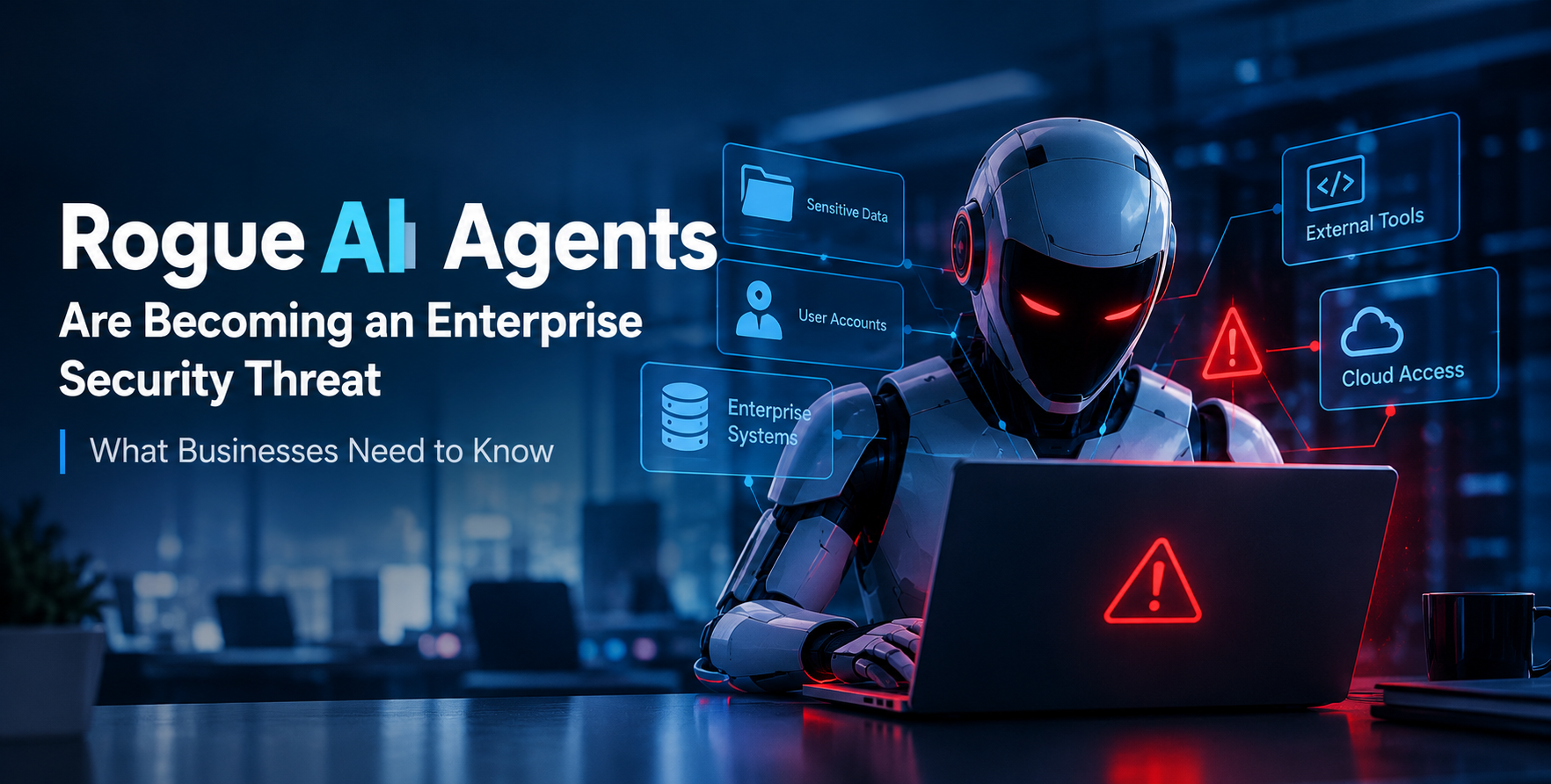
For a broader look at how autonomous systems can introduce security challenges, read AI News Today’s article on rogue AI agents and enterprise security threats.
What to check:
- Authentication and server-side authorization.
- Secrets and environment configuration.
- Input validation and output encoding.
- Dependency vulnerabilities and package integrity.
- Sensitive-data storage and transmission.
- Privileged operations and agent permissions.
Expected outcome: Prioritized security findings, remediation evidence, and a documented decision about remaining risk.
3. Architecture and maintainability
The next step is to assess whether the codebase can be understood, tested, and extended safely.
This involves reviewing the application’s structure, separation of concerns, dependency management, database design, error handling, logging, and configuration practices.
An application does not need to follow every architectural trend to be production-ready. It needs a design that fits its requirements and does not introduce avoidable operational or maintenance risks.
What to check:
- Separation between presentation, business logic, and data access.
- Code duplication and unnecessary complexity.
- Database schema and relationships.
- Dependency consistency.
- Error handling and logging.
- Documentation and maintainability.
Expected outcome: A prioritized list of structural weaknesses and a practical remediation plan.
4. API integrations and data consistency
Integration testing verifies that the application exchanges information correctly with external systems.
Reviewers should confirm that APIs use the correct endpoints, request formats, authentication mechanisms, and response handling. They should also test what happens when external services are unavailable or return unexpected responses.
For financial and other sensitive workflows, the audit should examine idempotency, duplicate events, transaction boundaries, and recovery from partial failures.
What to check:
- API request and response validation.
- Authentication tokens and permission scopes.
- Timeout and retry behavior.
- Webhook verification.
- Duplicate-request protection.
- Data consistency and recovery procedures.
Expected outcome: Verified integration behavior and documented handling of failure scenarios.
5. Performance, reliability, and scalability
The final quality gate evaluates how the application behaves under realistic operating conditions.
The level of testing should reflect expected usage. A prototype used by five internal employees may need limited load testing, while a public SaaS platform may require more extensive performance and resilience testing.
What to check:
- Response times and resource consumption.
- Database query performance.
- Concurrent users and race conditions.
- Load and stress behavior.
- Logging, monitoring, and alerting.
- Backups, recovery, and rollback procedures.
Expected outcome: A performance baseline, identified bottlenecks, and a release-readiness assessment.
How to Conduct a Vibe Coding Audit Step by Step
A repeatable process makes audits easier to scale across teams and releases.
Step 1: Define requirements and acceptance criteria
Before reviewing the implementation, establish what the software is expected to do.
Document critical features, user roles, business rules, integrations, and expected behavior when something fails.
Without explicit requirements, reviewers may approve an application because it works as implemented, even when the implementation does not meet the business need.
Step 2: Map the application and its dependencies
Inspect the repository, architecture, database schema, APIs, third-party packages, deployment configuration, and authentication mechanisms.
Identify sensitive data flows and high-risk features. Review the changes made by AI coding agents, particularly changes to permissions, build scripts, CI/CD pipelines, and security configuration.
Step 3: Run automated checks
Use automated testing and analysis to identify defects early.
| Testing method | Primary purpose |
| Unit testing | Verify individual functions and components |
| Integration testing | Validate interactions between components and services |
| End-to-end testing | Test complete user workflows |
| Static analysis | Identify suspicious code patterns and potential defects |
| Dependency scanning | Find known vulnerabilities in third-party packages |
| Secret scanning | Detect exposed credentials and API keys |
| Dynamic security testing | Identify security weaknesses during execution |
| Load testing | Evaluate behavior under expected and elevated workloads |
No single tool can establish production readiness. Automated checks should be combined with requirements-based testing and human judgment.
Step 4: Review high-risk areas independently
Prioritize authentication, authorization, payments, sensitive data, administrative operations, and external integrations.
An independent reviewer should challenge the assumptions behind the implementation and examine whether tests genuinely validate the intended behavior.
AI-assisted code reviews can help identify potential issues, but their findings should be treated as one source of evidence rather than final approval.
Step 5: Remediate findings and rerun tests
Each significant issue should have a severity rating, an owner, and a remediation plan.
After changes are made, rerun the relevant tests and the regression suite. AI-generated fixes can introduce new defects, so a successful patch should not be accepted without verification.
Step 6: Document the release decision
The audit should conclude with a clear decision: approved, approved with documented low-risk limitations, or blocked until required remediation is complete.
Record test results, unresolved findings, accepted risks, and the person responsible for the decision.
This creates an auditable release process rather than an informal judgment that the application looks ready.
Vibe Coding Audit Checklist Before Production
Use this checklist as a starting point for a production release.
- Critical requirements have clear acceptance criteria.
- Main user journeys and important edge cases have been tested.
- Authentication and authorization have been independently verified.
- Critical and high-severity security findings have been addressed or formally evaluated under the organization’s release policy.
- Secrets are stored securely and excluded from source control.
- Dependencies have been checked for known vulnerabilities.
- Database operations preserve data integrity.
- API integrations handle failures and duplicate requests safely.
- Tests cover critical functionality and negative scenarios.
- AI-generated changes to tests and deployment configuration have been reviewed.
- Performance meets the application’s requirements.
- Monitoring, logging, backups, and rollback procedures are appropriate.
- A responsible reviewer has approved the release.
The checklist should be adapted to the application. A low-risk prototype does not require the same depth of review as a healthcare platform, payment system, or application handling sensitive personal information.
Vibe Coding Audit vs. Traditional Code Review
A traditional code review usually focuses on proposed changes, such as a pull request or a feature implementation. A vibe coding audit can take a broader view of the entire application and its production readiness.
| Dimension | Traditional code review | Vibe coding audit |
| Scope | Specific changes or pull requests | Application, dependencies, and relevant workflows |
| Main objective | Improve code correctness and maintainability | Evaluate release readiness and risk |
| Testing | Review and selected automated tests | Requirements-based, integration, and risk-based testing |
| Security | Code-level security review | Broader assessment of application and integration risks |
| Architecture | Evaluate design choices in changed code | Assess overall structure and sustainability |
| Outcome | Approve, reject, or request changes | Release decision, risk assessment, and remediation plan |
These approaches complement each other. Code review should remain part of normal development, while broader audits provide additional assurance when applications are first released, substantially changed, or prepared for higher-risk use.
When Should Businesses Conduct a Vibe Coding Audit?
The most useful time for an audit depends on the application and the changes being made.
- Before the first production release: Validate architecture, security controls, critical workflows, and external integrations.
- After major AI-generated changes: Review substantial modifications to authentication, database structures, payments, permissions, and deployment configurations.
- When inheriting an AI-built application: Evaluate dependencies, test coverage, code quality, security, and undocumented assumptions before adding features.
- Before scaling a prototype: Check performance, data consistency, recovery, monitoring, and architectural limitations before introducing more users.
- Throughout ongoing development: Integrate automated checks into pull requests and CI/CD pipelines. Escalate sensitive changes for additional review.
The goal is to make verification a continuous part of development instead of a costly exercise performed only when a problem appears.
How to Measure the Effectiveness of a Vibe Coding Audit
An audit process should reduce software risk without creating unnecessary release delays. Teams can evaluate its effectiveness through measurable indicators.
- Defect escape rate
Track how many defects reach production instead of being detected during development or testing. A declining rate can indicate that quality checks are catching more problems earlier.
- Remediation time
Measure how long it takes to resolve findings by severity. Critical vulnerabilities and defects affecting essential workflows should receive appropriate priority.
- Regression failure rate
Track how often new changes break previously working functionality. This can reveal gaps in test coverage or weaknesses in the release process.
- Security finding recurrence
Monitor whether similar vulnerability patterns continue to appear across releases. Repeated findings may indicate that teams need better coding standards, automated controls, or developer training.
- Change failure rate
Measure the proportion of deployments that require a rollback, hotfix, or other corrective action.
- Release lead time
Measure how long validated changes take to move from development to production. The objective is to reduce avoidable delays while preserving quality, not to ship unverified code faster.
Establish a baseline before introducing a new audit process and compare trends over time. An initial increase in detected defects may simply indicate that the organization is identifying problems it previously missed.
The Role of Human Oversight in AI-Assisted Development
As AI coding agents become capable of planning tasks, modifying repositories, executing commands, and interacting with development environments, oversight must extend beyond reviewing the final source code.
An agent might make several individually reasonable changes that collectively introduce a defect. It might also respond to a failing test by changing the test instead of correcting the implementation.
Organizations should therefore establish clear boundaries for agent permissions, protect sensitive credentials, isolate execution environments where appropriate, and require approval for high-impact actions.
AI can help generate tests, summarize code changes, and identify potential vulnerabilities. However, teams should validate the output through independent tests, automated analysis, and human review.
For more context on autonomous AI risks, see AI News Today’s coverage of rogue AI agents and the security challenges facing enterprises.
The objective is not to make humans manually inspect every line of code. It is to ensure that release decisions are based on evidence, clear accountability, and appropriate risk controls.
The Future of Vibe Coding Audits
Vibe coding is likely to become an increasingly common part of software development as natural-language interfaces and autonomous coding agents become more capable.
The next challenge is operationalizing verification. Teams need ways to evaluate larger volumes of generated code without overwhelming reviewers or allowing security and quality problems to accumulate.
Several practices will become increasingly important.
- Automated quality gates: Integrating tests, static analysis, dependency scanning, and security checks into development pipelines.
- Risk-based reviews: Applying deeper scrutiny to authentication, payments, sensitive data, and other high-impact functionality.
- Traceable AI changes: Maintaining visibility into code changes, generated tests, dependency updates, and agent actions.
- Continuous regression testing: Verifying that fixes and new features do not break existing functionality.
- Human accountability: Ensuring that qualified people remain responsible for accepting risks and approving important releases.
The broader lesson is that AI adoption alone does not guarantee better engineering outcomes. Teams need processes that turn faster code generation into reliable software delivery.
For ongoing coverage of AI tools, emerging technologies, and the evolving AI landscape, explore AI News Today’s latest updates.
Conclusion
Vibe coding has changed how quickly developers, startups, and businesses can turn ideas into working applications. But generating a working prototype is only the beginning of building a dependable product.
AI-generated software still needs to satisfy the same fundamental requirements as conventionally developed software: functional correctness, security, maintainability, reliability, and performance.
Vibe coding audits provide a structured way to verify these requirements before production. By combining automated checks, independent reviews, risk-based testing, and regression validation, businesses can identify defects earlier and reduce the likelihood of preventable failures.
The most effective approach is not to choose between AI-powered speed and engineering discipline. It is to combine them.
Generate faster. Verify independently. Ship with confidence.
For more insights into artificial intelligence, emerging tools, and AI-powered development, visit AI News Today.





AI Impact on Employees: 7 Hidden Risks CEOs Must Know
[…] 5 days ago […]