
Artificial intelligence is moving beyond generating individual images and short video clips. AI tools are increasingly being tested as a way to create longer, story-driven entertainment, and Elon Musk’s latest project offers another example of that shift.
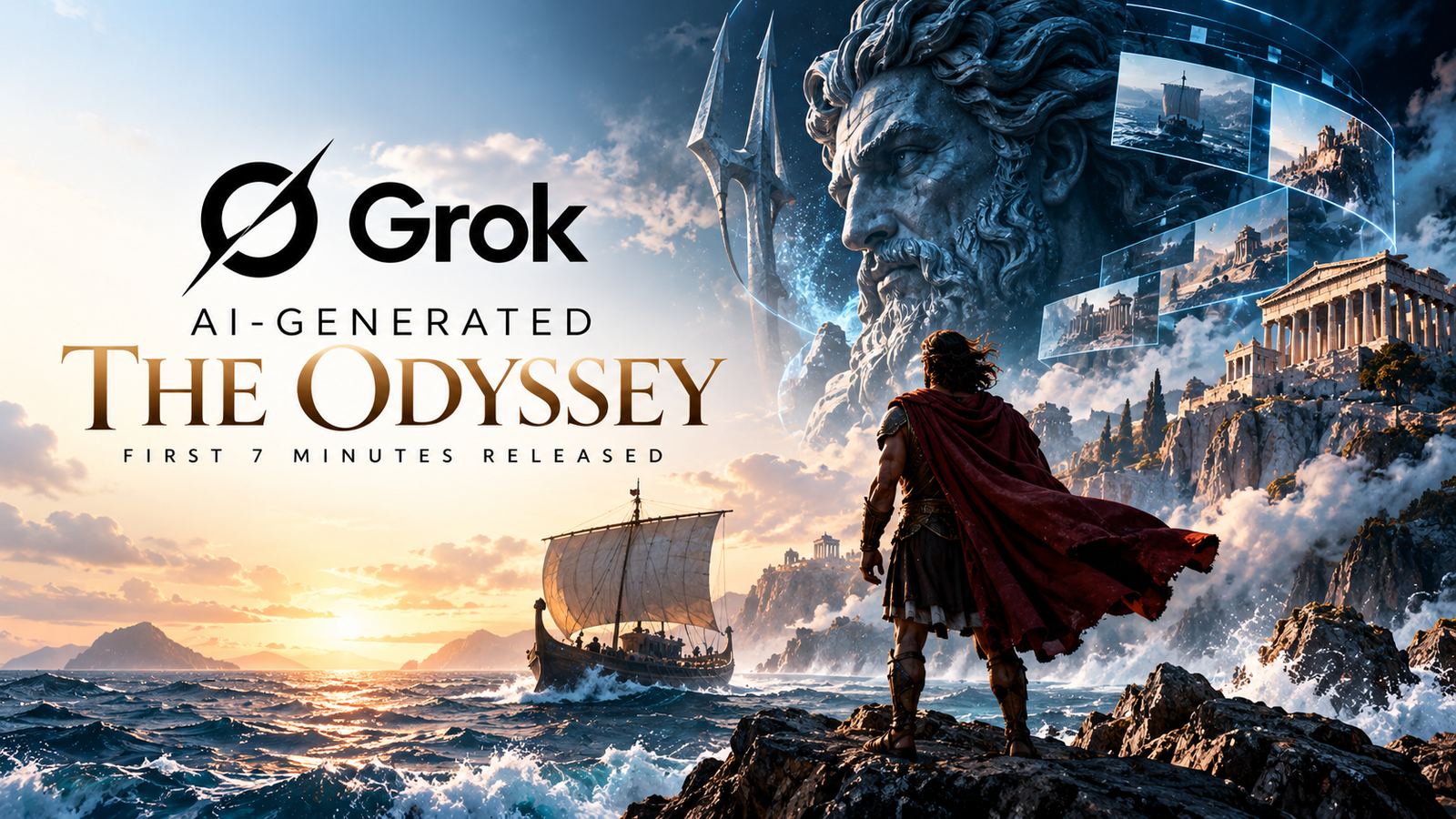
On October 23, 2026, Grok Imagine released the first seven minutes of its AI-generated adaptation of The Odyssey on X. The project, developed in collaboration with Wonder Studios and director Dev Walker, marks a step toward Musk’s previously announced ambition to produce a full-length AI-generated version of Homer’s ancient Greek epic.
However, the release raises a bigger question for the entertainment industry: Can AI generate an entire movie that audiences genuinely want to watch, or is it still better at producing convincing visuals than telling compelling stories?
What Is Grok’s AI-Generated The Odyssey?
The Odyssey is a foundational work of ancient Greek literature. Traditionally attributed to Homer, the epic follows Odysseus on his long and dangerous journey home to Ithaca after the Trojan War.
The story features mythical creatures, powerful gods, dramatic encounters, and themes of perseverance, loyalty, identity, and survival. Its scale and visual possibilities make it an ambitious subject for any filmmaker.
Grok Imagine, the image and video generation technology associated with Elon Musk’s AI platform Grok, is being used to bring this story to the screen through AI-generated footage.
The newly released seven-minute video is presented as the first episode of an Odyssey series rather than a completed feature film. The release credits creative collaboration with Wonder Studios and director Dev Walker.
According to research, the footage demonstrates that Grok can generate scenes that occasionally resemble live-action filmmaking. However, the report also raises concerns about the video’s pacing, dialogue, and lack of emotional engagement.
The distinction matters. Producing realistic-looking scenes is one challenge; building a narrative that keeps audiences invested is another.
From a Full-Length Movie Promise to a Seven-Minute Release
The project follows an earlier announcement by Musk in July 2026. At the time, he said Grok Imagine would produce a full-length movie adaptation of The Odyssey before the end of the year, describing the intended film as historically accurate and faithful to Homer’s work.
The first episode provides an early look at that ambition, but it does not establish that a full-length movie has been completed or that the original timeline will be met.
The release also arrives amid broader debate over AI-generated entertainment and the role of technology in traditional filmmaking.
Musk has publicly criticized Christopher Nolan’s adaptation of The Odyssey, particularly its casting choices. The two projects, therefore, represent contrasting approaches to adapting the same literary work: one grounded in conventional filmmaking, and another built around generative AI.
These differences extend beyond the production process. Traditional films rely on the coordinated work of actors, cinematographers, production designers, editors, sound professionals, and many other specialists. An AI-led production attempts to automate or substantially change parts of that process.
The central question is whether those changes can reduce production barriers without sacrificing the creative qualities that make films memorable. Read more updates
What the First Episode Reveals About AI Filmmaking
The initial footage offers a useful opportunity to examine both the capabilities and limitations of generative video.
1. AI Can Produce More Convincing Visual Scenes
One of the notable aspects of the footage is that some shots appear reasonably realistic. Characters, environments, and maritime scenes can resemble elements of a conventional live-action production.
This illustrates the progress of generative video technology. AI systems can now produce visual sequences rather than only static images, giving creators new ways to experiment with scenes and cinematic concepts.
However, visual realism alone does not guarantee consistency. A successful feature film must maintain believable characters, coherent environments, appropriate movement, and continuity across scenes.
2. Longer Videos Introduce New Challenges
Generating a short clip and producing a coherent feature-length film are fundamentally different tasks.
A longer production must preserve character appearances, locations, costumes, visual style, and narrative details across multiple scenes. It also needs to establish relationships between events and maintain a consistent sense of time and space.
Even if an AI system generates an impressive individual shot, repeating that quality across an entire movie requires a more complex workflow.
The seven-minute release is an early example of a longer-form project, but it is not sufficient evidence that these challenges have been solved.
3. Realistic Dialogue Is Not the Same as Good Storytelling
According to TechCrunch’s assessment, the episode’s narration and dialogue lack much of the artistry and emotional engagement expected from a compelling film.
This highlights an important distinction between generating content and directing a story.
A strong adaptation needs more than characters delivering lines. It requires tension, meaningful character development, emotional transitions, and a sense of progression that encourages viewers to keep watching.
Generative AI can assist with dialogue, visual concepts, and scene creation. Yet the finished experience still depends on how those elements are selected, arranged, refined, and connected.
How AI Could Change Film Production
Despite the limitations visible in the first episode, AI-generated filmmaking could become useful in several areas of the entertainment industry.
- Previsualization and storyboarding: Filmmakers could use generative tools to turn scripts into rough visual sequences before committing to expensive production schedules.
- Virtual environments and background creation: AI-generated landscapes, historical settings, and conceptual environments could help production teams explore visual directions more quickly.
- Independent filmmaking: Creators with limited budgets could experiment with cinematic concepts that would otherwise require expensive locations, equipment, or visual-effects work.
- Rapid creative iteration: Directors and production teams could test different scene compositions, lighting approaches, or visual styles before choosing a final direction.
- Experimental storytelling: AI tools could make it easier to explore unusual narrative formats, interactive experiences, and short-form visual stories.
These applications do not necessarily require AI to replace the entire filmmaking process. In many cases, using AI as one part of a human-led production workflow may prove more practical than attempting to automate every creative decision.
AI Filmmaking vs. Traditional Hollywood Production
The Grok project also illustrates the differences between AI-generated content and conventional movie production.
| Factor | AI-generated filmmaking | Traditional filmmaking |
|---|---|---|
| Visual creation | Generated through AI models and creative direction | Created through physical production, digital tools, or a combination |
| Actors | May use AI-generated characters | Typically involves human performers |
| Production workflow | Relies on prompts, model outputs, selection, and editing | Coordinates cast, crew, locations, equipment, and post-production |
| Creative control | Requires oversight of generated outputs and consistency | Distributed across directors, performers, and creative departments |
| Key challenge | Maintaining continuity and narrative quality | Managing production complexity, budgets, and schedules |
This comparison is not absolute. Traditional productions already use extensive computer-generated imagery, virtual production, and automated post-production tools. AI-generated films can also involve human directors, writers, editors, and artists.
The more useful distinction is how much of the creative and production process is generated or automated, and how effectively people maintain control over the final result.
The Bigger Question: Can AI Replace Human Creativity?
Grok’s The Odyssey project brings a longstanding debate into sharper focus: Is generating a visually convincing movie enough to make it successful?
The answer depends on what audiences value.
Some viewers may be interested in AI-generated films because they offer unusual visual styles, lower barriers to experimentation, or new interpretations of familiar stories. Others may place greater importance on human performances, carefully constructed dialogue, directorial vision, and the collaborative process behind a production.
There are also broader questions surrounding the use of copyrighted material, training data, performers’ likenesses, voice replication, and the credit or compensation owed to creative professionals. These issues become especially important as AI-generated entertainment moves toward commercial distribution.
The release of a seven-minute episode does not resolve those questions. Instead, it provides another example of how generative AI is entering creative industries faster than their working practices and standards are fully adapting.
What Comes Next for Grok Imagine?
The first episode establishes that Grok Imagine is being used for a longer-form adaptation of The Odyssey. The next important milestone will be whether the project develops into a coherent, full-length production.
That assessment will require more than looking at isolated shots. Viewers will need to evaluate narrative continuity, character consistency, dialogue, pacing, sound, and the overall quality of the finished experience.
Musk’s earlier announcement set a target of delivering a full-length version before the end of 2026. As of the October 25 report, the seven-minute episode represents only an initial release, and the completion of the promised feature remains unconfirmed.
The project could help demonstrate how far AI video generation has progressed. It could also reveal why long-form storytelling remains difficult to automate, even when individual images and scenes look convincing.
Final Thoughts
Grok’s AI-generated The Odyssey is another sign that generative AI is expanding from short-form content into more ambitious entertainment projects.
Its first seven minutes demonstrate the potential for AI-generated cinematic visuals while highlighting the gap between technical capability and compelling storytelling.
For filmmakers, the opportunity may lie in using AI to accelerate production, test creative ideas, and expand access to visual storytelling. For AI developers, the challenge is to improve consistency, narrative control, and the quality of longer sequences.
Ultimately, the success of AI filmmaking will not depend solely on whether a machine can generate a movie. It will depend on whether the finished work can hold an audience’s attention, create an emotional connection, and deliver a story worth experiencing.


Leave a Reply