
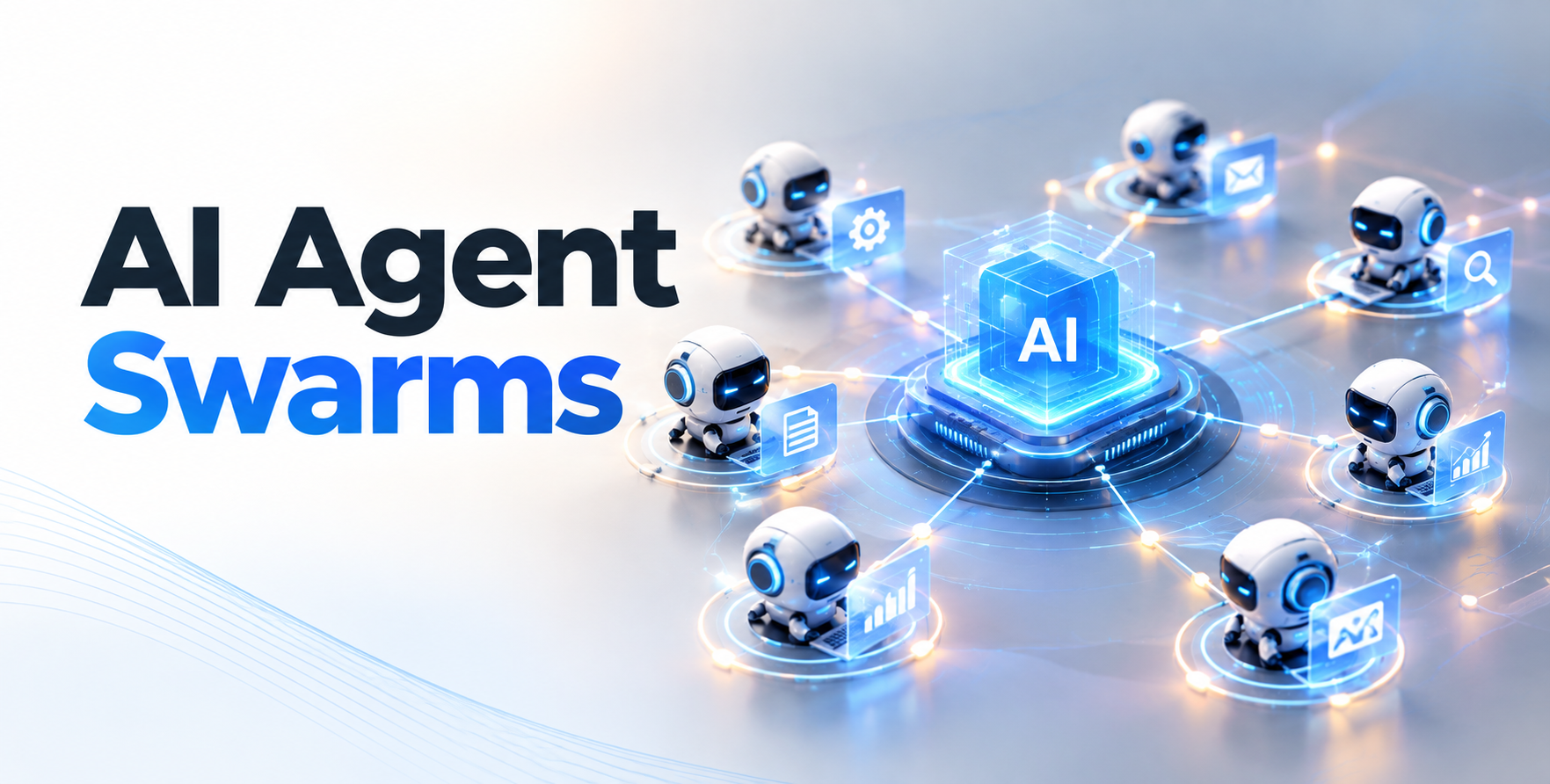
Artificial intelligence is moving beyond simple chatbots and single-model assistants toward systems that can plan tasks, use tools, analyze information, and collaborate to achieve complex goals. One of the most interesting developments in this field is the emergence of AI agent swarms—groups of specialized AI agents that work together to complete tasks more efficiently.
Traditionally, businesses have relied on powerful AI models to handle a wide range of activities, from answering customer questions to generating reports and analyzing data. However, using a large model for every task can increase operational costs and create unnecessary complexity. AI agent swarms offer another approach: divide a complicated task into smaller components and assign each component to an agent with a specific responsibility.
This approach could make business automation more flexible, scalable, and accessible. Smaller AI models may handle individual tasks such as summarizing documents, extracting information, checking code, or classifying customer requests, while a coordinating agent manages the overall workflow.
For readers interested in emerging technologies, business applications, and the latest artificial intelligence developments, AI News Today offers a useful starting point for exploring how AI is changing the digital landscape.
As organizations look for practical ways to implement AI without dramatically increasing their technology budgets, agent swarms are becoming an important area to watch. But how do they work, what advantages can smaller models provide, and what challenges must businesses address before adopting this technology?
For the latest updates on artificial intelligence, emerging technologies, and industry trends, visit AI News Today , a platform covering developments shaping the future of AI.
What Are AI Agent Swarms?
An AI agent swarm is a system in which multiple AI agents collaborate to achieve a shared objective. Each agent may have its own instructions, tools, responsibilities, and access to information. Instead of expecting one AI system to manage every part of a complicated process, the swarm distributes work among several agents.
Consider a company preparing a market research report. A traditional AI assistant might attempt to research competitors, identify customer trends, summarize industry developments, and prepare recommendations within one workflow. An agent swarm could divide these responsibilities among several specialized agents.
For example:
A research agent gathers information from approved sources.
An analysis agent identifies patterns and compares relevant data.
A fact-checking agent reviews important claims and identifies inconsistencies.
A writing agent organizes the findings into a structured report.
A coordinating agent combines the results and checks whether the original objective has been achieved.
This arrangement allows different parts of a project to be handled separately while remaining connected to the same goal.
AI agent swarms are related to multi-agent systems, a broader category of technologies in which multiple agents interact within a shared environment. The exact architecture varies. Some systems rely on a central coordinator, while others allow agents to communicate and coordinate more independently.
The important principle is not simply having multiple AI models running simultaneously. It is organizing their work so that their individual contributions produce a useful combined result.
Why Smaller AI Models Matter for Business Automation
Large AI models can perform a broad range of sophisticated tasks, but they are not necessarily the most economical choice for every operation. Many business processes involve relatively narrow activities that do not require the capabilities of the largest available model.
Examples include identifying invoice numbers, sorting support tickets, extracting dates from documents, categorizing feedback, and checking whether a form contains the required information.
Smaller models can be suitable for these focused responsibilities, particularly when they have been selected, configured, or fine-tuned for a specific task.
When multiple specialized agents work together, a business may be able to combine smaller models with a more capable model used only for complex decisions.
For instance, a customer service workflow could use a lightweight model to identify the purpose of an incoming message, another model to retrieve relevant policy information, and a more capable model to handle unusual or complicated requests.
This design creates opportunities to control costs while retaining flexibility.
However, smaller models are not automatically cheaper or better in every situation. Running multiple agents introduces additional inference requests, communication overhead, monitoring requirements, and potential delays. A swarm is economically attractive only when the savings from using specialized models and distributing work outweigh those additional costs.
The real opportunity lies in choosing the appropriate model for each task rather than assuming that either the largest or smallest model is always the best option.
How AI Agent Swarms Work
AI agent swarms generally follow a structured process involving task planning, delegation, execution, coordination, and review.
1. Breaking a Large Task Into Smaller Tasks
The process begins when a business provides an objective, such as analyzing customer feedback across thousands of support conversations.
A planning agent or predefined workflow determines which activities are necessary. These might include organizing the conversations, identifying recurring complaints, detecting sentiment, comparing trends, and preparing a summary.
Breaking a large objective into manageable components makes it easier to assign work and monitor progress.
2. Assigning Responsibilities to Specialized Agents
Once the task has been divided, individual agents receive specific responsibilities.
One agent might focus on extracting information, while another categorizes the results. A third could identify unusual patterns or check whether the findings are supported by the available evidence.
Each agent can use a model suited to its responsibilities. Simple classification may require only a compact model, while interpreting complicated customer complaints might require a more capable system.
Clear responsibilities also reduce the risk of agents duplicating work unnecessarily.
3. Allowing Agents to Work Independently or in Parallel
Some tasks can be completed simultaneously. For example, separate agents could analyze customer feedback from different product categories or investigate different competitors.
Parallel execution can reduce the time needed to complete a workflow when the tasks are sufficiently independent.
Other tasks must occur sequentially. An analysis agent may need to wait until a research agent has collected the relevant information before proceeding.
Effective swarm design identifies which activities can happen concurrently and which depend on earlier results.
4. Sharing Information and Coordinating Results
Agents need a reliable way to exchange information. Depending on the system, they may communicate through messages, shared memory, structured outputs, databases, or an orchestration layer.
A coordinating component can monitor progress, identify missing information, and decide when the results are ready to be combined.
Without suitable coordination, agents might produce conflicting answers, repeat the same research, or work with outdated information.
5. Reviewing the Final Output
The last stage involves checking whether the combined result meets the original objective.
A review agent can examine important claims, compare outputs, and flag inconsistencies. For sensitive business processes, a human reviewer may need to approve the result before it is published or used to make a decision.
This final review is essential because multiple AI agents can still make mistakes. Collaboration does not automatically guarantee accuracy.
Practical Business Applications of AI Agent Swarms
AI agent swarms could support a variety of business operations, especially where work involves multiple steps or different types of expertise.
Customer Support Automation
Customer support teams manage questions about orders, returns, payments, product features, and technical issues.
An agent swarm could classify incoming requests, retrieve relevant information, draft responses, and identify cases that require human intervention.
A straightforward question could be resolved through an automated workflow, while a complicated complaint could be routed to a human representative with a summary of the previous interactions.
Businesses would still need safeguards to prevent unauthorized refunds, incorrect promises, or inappropriate handling of sensitive customer information.
Marketing and Content Production
Marketing teams often combine audience research, competitor analysis, keyword research, content planning, drafting, and performance evaluation.
A coordinated group of agents could assist with these activities. One agent might analyze search intent, another could organize topic ideas, and another could review drafts for clarity, factual consistency, and brand guidelines.
Human editors would remain important for originality, accuracy, strategic judgment, and maintaining a recognizable brand voice.
AI agents can accelerate parts of content production, but publishing more material does not automatically lead to better search rankings or stronger audience engagement.
Software Development
Software projects involve requirements analysis, coding, testing, documentation, debugging, and code review.
Different agents could assist with separate parts of the development process. A planning agent might divide a feature into smaller tasks, coding agents could work on separate components, and a testing agent could evaluate the results.
A review agent could flag potential bugs or security problems before the changes are merged.
Human developers would still need to evaluate the architecture, review consequential changes, and ensure that the resulting software behaves as intended.
Financial and Administrative Operations
Organizations process invoices, expense reports, purchase orders, and other administrative documents.
Specialized agents could extract information, compare records, identify missing fields, and flag discrepancies for review.
For example, one agent could extract invoice details while another checks whether the corresponding purchase order exists. A third could identify inconsistencies that require human approval.
These workflows may reduce repetitive manual work, but financial transactions should remain subject to appropriate access controls, verification, and approval procedures.
Sales and Market Research
Sales teams frequently research prospects, analyze market segments, prepare meeting summaries, and organize follow-up activities.
A group of agents could gather information from approved sources, summarize company developments, identify potential customer needs, and prepare a briefing for a sales representative.
This could help employees spend less time gathering routine information and more time building relationships and making decisions.
The system should distinguish verified information from assumptions and respect privacy requirements when processing customer data.
The Advantages of Combining Smaller Models
The combination of specialized agents and smaller AI models offers several potential benefits.
Lower costs for suitable tasks: Smaller models may require fewer computational resources per request, making them attractive for high-volume activities such as classification and information extraction.
Greater flexibility: Organizations can select different models for different responsibilities instead of depending on one model for every operation.
Parallel processing: Independent tasks can be performed simultaneously, potentially reducing overall completion time.
Improved specialization: Agents with narrow responsibilities can be configured around specific tools, instructions, and evaluation criteria.
Easier workflow customization: Businesses can modify an individual agent or workflow component without necessarily redesigning the entire system.
More structured quality checks: Separate review agents can identify inconsistencies or missing information before the final output reaches a user.
These advantages depend on the implementation. Smaller models may struggle with tasks requiring deep reasoning, complex context, or subtle interpretation. A business must evaluate whether the complete system performs better than a simpler alternative.
Challenges Businesses Must Consider
Despite their potential, AI agent swarms introduce technical and operational challenges.
Coordination Complexity
As the number of agents grows, managing communication, dependencies, and conflicting results can become more difficult.
A poorly designed swarm may spend more time coordinating than completing useful work. Organizations should start with a limited number of clearly defined agents and expand only when the benefits are demonstrated.
Reliability and Error Propagation
An agent can produce incorrect information that another agent accepts as accurate. If the error passes through several stages, it may become harder to detect.
Structured outputs, validation rules, independent checks, and human review can help reduce this risk.
Security and Data Privacy
Agents may interact with internal documents, customer records, external websites, and business applications. Excessive permissions can create unnecessary risks.
Each agent should receive only the access required for its responsibilities. Sensitive actions should use appropriate authorization, logging, and approval mechanisms.
Model Selection and Evaluation
A smaller model may perform well on a narrow classification task but struggle when asked to interpret ambiguous information.
Businesses should test candidate models using representative examples and measure accuracy, response time, cost, and failure rates before deploying them in production.
Hidden Operational Costs
Although individual small-model requests may be inexpensive, a workflow involving many agents can generate substantial cumulative costs.
Repeated attempts, long prompts, tool calls, monitoring, and data processing can increase total expenses. Organizations should measure the cost of completing an entire business task rather than comparing model prices in isolation.
How Businesses Can Start Using AI Agent Swarms
Companies interested in this technology should begin with a specific problem rather than trying to automate an entire department immediately.
First, identify a repetitive workflow with clear inputs and measurable outcomes. Document the steps employees currently perform and determine which activities can be automated safely.
Second, establish a baseline. Measure how much time the process takes, how frequently errors occur, and what it costs to complete.
Third, build a small prototype with only the agents required to demonstrate the intended benefit. For example, a document-processing workflow might begin with one extraction agent and one validation agent.
Fourth, evaluate the system using realistic test cases. Measure accuracy, processing time, total cost, and the number of cases requiring human intervention.
Fifth, introduce safeguards. Set permissions, establish escalation rules, record important actions, and require approval for sensitive or irreversible operations.
Finally, compare the prototype against the original process and a simpler single-agent alternative. Expand the system only when the results justify the additional complexity.
This measured approach helps organizations avoid investing in elaborate architectures before proving that the technology solves a real problem.
The Future of AI Agent Swarms in Business
AI agent swarms could become an important part of enterprise automation as models, orchestration tools, and deployment infrastructure continue to evolve.
One possible direction is the development of systems that dynamically assign work to different models based on task difficulty, cost, and performance requirements. Straightforward activities could be handled by smaller models, while more complex decisions could be escalated to more capable systems.
Another potential development is the integration of agent workflows into existing business applications. Rather than operating as separate AI experiments, agents could assist with processes involving customer relationship management, document management, software development, and internal reporting.
Better evaluation and monitoring tools could also make it easier to understand how agents interact, identify failures, and control operational costs.
Nevertheless, widespread adoption will depend on more than model performance. Businesses will need reliable integrations, clear accountability, effective security controls, and evidence that multi-agent workflows deliver meaningful improvements over simpler solutions.
The most successful implementations may not be the largest swarms. They may be carefully designed systems that use a small number of specialized agents to solve well-defined problems.
Conclusion
AI agent swarms represent a promising approach to business automation because they allow organizations to divide complex work among specialized AI agents rather than relying on a single system for every task.
When combined with appropriately selected smaller models, these systems could make certain workflows more economical, flexible, and scalable. Potential applications include customer support, marketing operations, software development, document processing, and market research.
However, the benefits are not guaranteed. Coordination overhead, inaccurate outputs, security risks, and cumulative operating costs can outweigh the advantages if a swarm is poorly designed.
Businesses should therefore focus on measurable outcomes rather than the number of agents they deploy. By starting with a specific use case, testing smaller models carefully, introducing suitable safeguards, and comparing results against simpler alternatives, organizations can determine where agent swarms offer genuine value.
The future of business automation may involve teams of AI agents working together, but success will depend on choosing the right tasks, the right models, and the right level of human oversight.
Frequently Asked Questions
1. What are AI agent swarms?
AI agent swarms are systems in which multiple AI agents collaborate to complete complex tasks. Each agent handles a specific responsibility, such as research, data analysis, planning, or quality checking, while working toward a shared objective.
2. How can smaller AI models improve business automation?
Smaller AI models can automate focused tasks using fewer computational resources in suitable scenarios. When combined with specialized AI agents, they can help businesses streamline workflows, manage repetitive activities, and potentially reduce operating costs.
3. What is the difference between AI agents and AI agent swarms?
A single AI agent performs tasks based on its instructions, tools, and capabilities. An AI agent swarm coordinates multiple agents, allowing them to divide responsibilities, exchange information, and work together on more complex objectives.
4. Which industries can benefit from AI agent swarms?
Industries such as healthcare administration, finance, e-commerce, marketing, customer service, and software development may benefit from AI agent swarms. Potential applications include document processing, customer support, data analysis, software testing, and market research.
5. Are AI agent swarms more cost-effective than large AI models?
They can be more cost-effective when smaller models handle simpler tasks and more powerful models are reserved for complex work. However, communication between agents, repeated model calls, infrastructure, and monitoring can increase total costs, so businesses should evaluate the complete workflow.
6. What challenges do businesses face when implementing AI agent swarms?
Common challenges include coordinating multiple agents, preventing errors from spreading between tasks, protecting sensitive data, managing operating costs, and maintaining reliable performance. Clear responsibilities, testing, security controls, and human oversight can help address these challenges.






Google AI Satellite: Space-Based Data Center Breakthrough
[…] AI Agent Swarms Explained: How Smaller AI Models Could Power the Next Generation of Business Automat… […]