
TL;DR
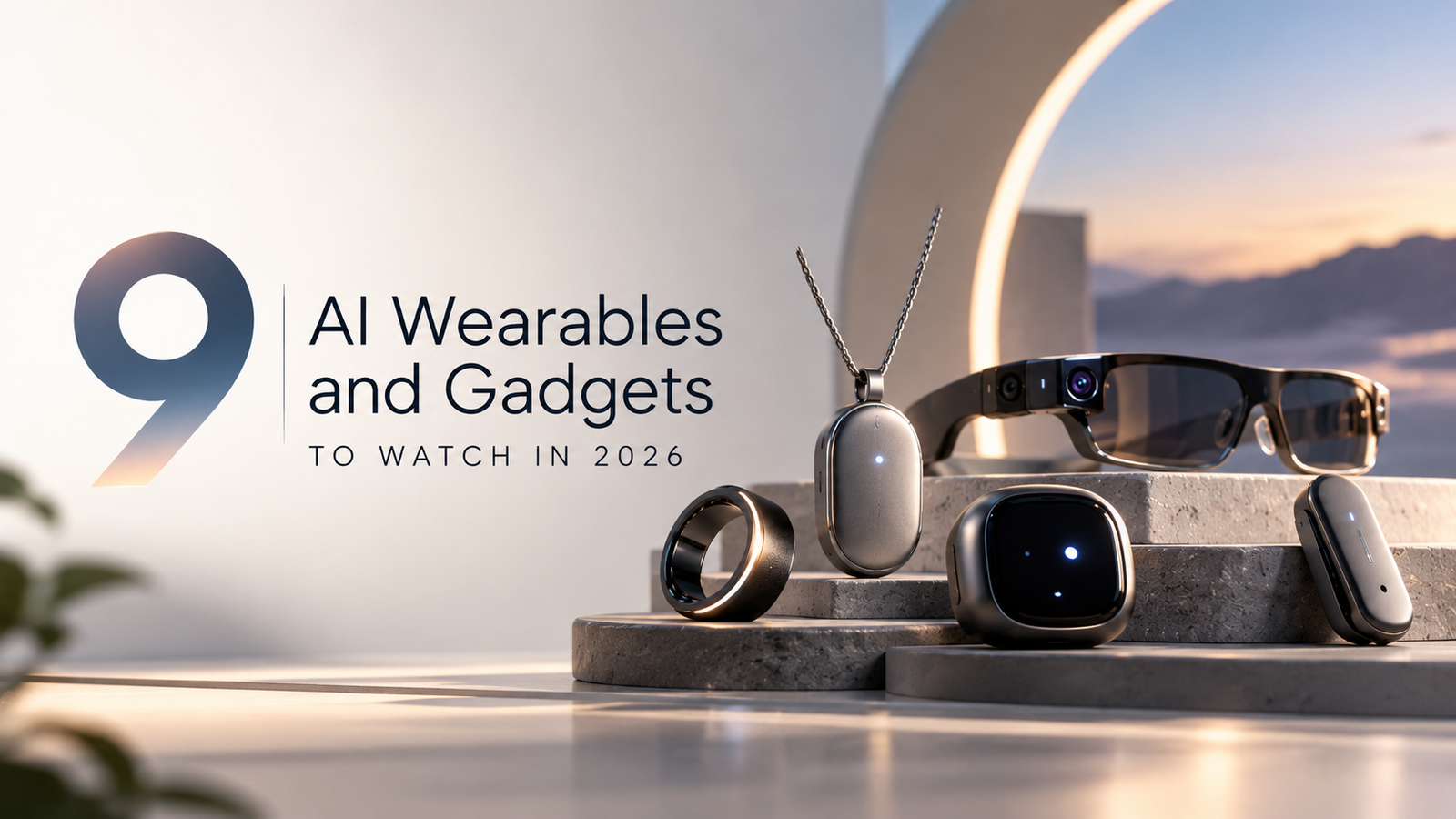
AI wearables and gadgets are compact devices that use artificial intelligence to record and summarize conversations, capture voice notes, provide hands-free assistance, or support personal reflection. Notable products include Amazon Bee, Friend, Limitless, Meta Muse Charm, Nirva, Omi, Plaud NotePin, Rabbit R1, and Sandbar Stream. Meta’s Ray-Ban smart glasses also illustrate how AI can be integrated into everyday accessories.
The best device depends on the intended use: Plaud and Bee focus on productivity, Friend emphasizes AI companionship, Nirva focuses on personal insights, and smart glasses offer hands-free interaction. Privacy, subscription costs, battery life, and real-world reliability remain important considerations.
Artificial intelligence is moving beyond smartphones and desktop applications into the devices people wear and carry every day. AI-powered pendants can capture conversations, smart rings can record quick voice notes, and connected glasses can assist without requiring users to reach for their phones.
This emerging category is known as ambient AI: technology designed to make assistance available in the background of everyday activities, rather than requiring users to open an app and enter a prompt.
The market is attracting established technology companies and startups. Amazon is expanding its Bee wearable lineup, Meta is experimenting with compact AI hardware, and startups such as Plaud, Omi, and Sandbar are exploring new ways to integrate AI into personal devices.
AI wearables and gadgets are evolving rapidly, introducing new ways to capture conversations, simplify everyday tasks, and access personal AI assistants. From AI-powered smart glasses and voice-recording rings to wearable note-taking devices and digital companions, these innovations are changing how people interact with technology.
As discussed in our guide to emerging AI technology trends, the shift toward more accessible, context-aware AI is creating new opportunities for consumer technology. But are these gadgets genuinely useful, and which ones deserve attention?
This guide explores nine notable AI wearables and gadgets in 2026, covering their features, reported prices, practical applications, and the challenges that could shape their adoption. Whether you’re interested in AI-powered productivity tools or the future of personal AI assistants, these devices offer a glimpse into how AI is moving beyond smartphones.
What Are AI Wearables and Gadgets?
AI wearables and gadgets are physical devices that integrate artificial intelligence with hardware such as microphones, cameras, sensors, speakers, and wireless connectivity.
They use AI models and companion software to interpret information, generate responses, organize data, or help users complete tasks.
Unlike traditional fitness wearables that primarily track activity and physical measurements, many AI-first devices focus on language, contextual assistance, personal memory, and productivity.
Common capabilities include:
- Transcribing meetings, lectures, and conversations.
- Summarizing long discussions into key takeaways.
- Capturing voice notes and creating reminders.
- Answering questions through voice interactions.
- Providing hands-free assistance through smart glasses.
- Organizing personal information and daily reflections.
Some devices focus on one task, such as transcription. Others attempt to become personal AI companions that remain available throughout the day.
The distinction matters because a specialized device may be more reliable and useful than a gadget attempting to perform every possible AI task.
9 AI Wearables and Gadgets to Know in 2026
1. Amazon Bee: AI-Powered Conversation Memory
Best for: Everyday productivity, reminders, and conversation summaries.
Amazon’s Bee wearable lineup focuses on turning conversations into useful information. The original Bee device can be clipped to clothing or worn like a fitness band. Its companion app offers transcripts, summaries, key takeaways, and reminders.
Amazon acquired Bee in July 2025 and introduced two additional devices in October 2026.
- Bee: The original wearable, listed at $49.99.
- Bee Frontier: A wrist-worn or clip-on device priced at $74.99.
- Bee Eclipse: A credit-card-sized device that attaches magnetically to a smartphone, priced at $99.99.
The newer devices retain the core conversation-assistance concept, while the product ecosystem connects with Amazon’s Alexa services.
For professionals, students, and people who frequently discuss plans or tasks, the ability to turn conversations into reminders could reduce manual note-taking.
However, recording controls, supported integrations, subscription terms, and data retention policies should be reviewed before choosing a device.
Why it matters: Bee demonstrates how AI can help people retrieve information from everyday conversations instead of relying entirely on memory.
2. Friend: A Wearable AI Companion
Best for: Conversational interaction and personal companionship.
Friend takes a different approach to wearable AI. Rather than concentrating exclusively on workplace productivity, it is designed as a conversational companion.
The pendant connects to a smartphone through Bluetooth and uses AI to respond to users and provide conversational interactions. The device is priced at $129 and reports that its Friend 2.0 update introduces a built-in speaker.
The concept is to make AI interaction feel more immediate and personal, rather than requiring users to open a chatbot whenever they want to talk.
Potential applications include casual conversation, reminders, and a more personalized assistant experience.
However, a device designed around persistent listening also raises questions about privacy, emotional attachment, and the boundaries between useful assistance and excessive dependence on AI.
Why it matters: Friend represents the companion-focused side of consumer AI hardware. Its success depends on whether users find the experience genuinely useful and trustworthy.
3. Limitless: AI Memory for Meetings and Conversations
Best for: Professionals who need to retrieve information from discussions.
Limitless, formerly known as Rewind, developed an AI pendant focused on recording, transcribing, and summarizing conversations.
The device is designed to make information from meetings and discussions searchable, helping users recall decisions, retrieve details, and organize follow-up actions.
This is the pendant at $99 and describes a companion app with 10 hours of AI features per month, alongside an option for unlimited features at $29 per month.
Potential use cases include:
- Retrieving decisions made during meetings.
- Finding details from previous discussions.
- Organizing interview notes.
- Summarizing professional conversations.
These capabilities could benefit consultants, journalists, managers, and other professionals who process large amounts of spoken information.
However, Limitless is also an example of why product continuity matters in AI hardware. Meta acquired Limitless in December 2025, and the company subsequently announced that it would discontinue its products and services in 2026. Prospective buyers should verify current service availability rather than assume the device remains supported.
Why it matters: AI conversation memory is a valuable concept, but a wearable’s usefulness also depends on the company continuing to support its hardware and software.
4. Meta Muse Charm: A Compact AI Assistant
Best for: Users interested in a dedicated, portable AI companion.
Meta Muse Charm is a pocket-sized AI device designed to provide access to Meta’s Muse assistant.
Revealed in September 2026, the gadget features a small display showing Jolly, a digital character representing the assistant. It is designed to be carried in a pocket or attached to a keychain.
Users are expected to interact with Muse through voice commands and use the assistant to perform tasks.
Unlike a traditional smartphone, the device aims to make AI accessible without requiring users to unlock a screen or open an application.
However, Meta had not yet shipped the device at the time of the October roundup. Its final availability, price, and full capabilities should therefore be verified through official announcements.
Why it matters: Muse Charm illustrates how hardware design and personalization may influence the adoption of AI assistants. The device is not simply a smaller computer; it is an attempt to make AI interaction feel more immediate and approachable.
5. Nirva: AI for Personal Reflection
Best for: Personal journaling, self-reflection, and communication insights.
Nirva is developing a wearable that focuses on personal reflection rather than conventional meeting productivity.
Founded by former Meta Reality Labs employees, the company is building a pendant that can also be worn as a bracelet. The device is designed to focus on the wearer’s own speech and use AI to generate a personal journal and insights through a companion application.
Potential applications include identifying recurring themes in daily experiences, reviewing communication patterns, and generating reminders based on personal conversations.
Nirva announced a $25 million pre-Series A funding round in October 2026, bringing its total reported funding to $33 million. It is reported a planned price of $249, with orders expected to open in November and shipments to early users targeted for the end of the year.
These were announced plans, not confirmation that the device had shipped.
Nirva’s approach also raises an important question: how reliable are AI-generated interpretations of a person’s emotions or behavior? Such observations should be treated as prompts for reflection, not as definitive psychological assessments.
Why it matters: Nirva demonstrates that wearable AI is expanding into personal insights, but this category requires particularly careful handling of sensitive information.
6. Omi: A Wearable AI Assistant
Best for: Voice assistance, reminders, and task creation.
Omi is a compact AI wearable designed to help users interact with an assistant throughout the day.
Listed at $89 in roundup, the device can answer questions, summarize conversations, create to-do lists, and help users schedule meetings.
It can be worn as a necklace. Another distinctive feature is its ability to attach to the side of the head using medical tape, allowing the device to detect when the wearer is speaking to it.
The goal is to make AI interaction more convenient in situations where typing or opening a phone is inconvenient.
For example, a user might capture a quick reminder while walking or create a task after a discussion without manually entering information.
Why it matters: Omi illustrates how a simple, hands-free interface can make an AI assistant more accessible. Its practical value depends on response quality, battery life, compatibility, and reliable task execution.
7. Plaud NotePin: AI Note-Taking on the Go
Best for: Students, journalists, lawyers, and meeting-heavy professionals.
Plaud NotePin is a wearable AI recording device designed to convert spoken information into transcripts and summaries.
It can be worn on the wrist or attached to clothing. Its companion software processes recordings and organizes the resulting information, reducing the need to take notes manually.
This list NotePin at $159 and reports that it includes 300 free transcription minutes per month. A paid Pro plan increases the available transcription allowance.
Plaud has also introduced the Note Pro, a separate AI note-taking device listed at $179 in the roundup.
Potential applications include:
- Capturing lecture notes.
- Summarizing meetings.
- Organizing interview transcripts.
- Retrieving important details from discussions.
Unlike general-purpose AI companions, Plaud has a focused use case: capturing spoken information and making it easier to review.
Why it matters: AI note-taking hardware can be valuable when it saves time on a recurring task. Accuracy, language support, export options, and subscription costs are important factors to compare.
8. Rabbit R1: A Handheld AI Gadget
Best for: Users experimenting with AI-driven interactions and digital tasks.
Rabbit R1 differs from most products in this list because it is a handheld gadget rather than a wearable.
The compact device has a touchscreen and a rotating camera. It was designed to provide an alternative way to interact with digital services and complete tasks through an AI-oriented interface.
It lists Rabbit R1 at $199 and reports that software updates have expanded its features, including Creations, which allows users to build tools and games.
The device attracted attention for its distinctive design and its ambition to reduce reliance on conventional smartphone interactions.
However, Rabbit R1 also faced challenges during its initial launch, highlighting the difficulty of turning an ambitious AI concept into a dependable consumer product.
Why it matters: Rabbit R1 illustrates the difference between demonstrating AI capabilities and building a product that people consistently rely on. Reliable task completion and meaningful advantages over smartphones are essential to its long-term value.
9. Sandbar Stream: An AI Ring for Voice Notes
Best for: Discreet voice capture and quick reminders.
Sandbar’s Stream ring explores a different form factor for wearable AI.
The ring includes a microphone that remains off by default. Users can activate it through a touch-sensitive surface, record notes, interact with an AI assistant through a companion smartphone application, and control media playback.
This interaction model differs from products designed around continuous listening because recording is initiated through a deliberate action.
The ring’s compact design could make it convenient for capturing thoughts without taking out a smartphone. However, battery capacity, microphone performance, comfort, and control accuracy will be important considerations.
Why it matters: Sandbar demonstrates how AI functionality can be integrated into familiar accessories rather than requiring another screen or pendant.
What About Meta Ray-Ban Smart Glasses?
Meta Ray-Ban smart glasses are another important example of AI moving into everyday accessories, although they are separate from the nine entries in TechCrunch’s roundup.
Depending on the model and available software, users can capture photos and videos, interact with Meta AI, ask questions about their surroundings, and access audio features without holding a smartphone.
Smart glasses offer a different advantage from conversation-recording pendants. Their cameras can provide visual context, while microphones and speakers enable hands-free interaction.
For example, a traveler might ask for help understanding something in their surroundings or capture a photo without reaching for a phone.
However, camera-equipped wearables raise privacy concerns for people who may be recorded without realizing it.
Why it matters: Smart glasses show that the future of AI wearables may depend as much on useful interfaces and familiar designs as on the AI models themselves.
AI Wearables Compared: Which One Should You Choose?
The right device depends on the problem you want to solve. These products are not direct substitutes for one another.
| Device | Primary use | Reported price |
| Amazon Bee | Conversation summaries and reminders | $49.99 |
| Amazon Bee Frontier | Wearable conversation assistance | $74.99 |
| Amazon Bee Eclipse | Smartphone-mounted conversation assistance | $99.99 |
| Friend | AI companionship | $129 |
| Limitless | Conversation memory | $99 |
| Meta Muse Charm | Portable AI assistant | Not announced |
| Nirva | Personal journaling and insights | $249 planned |
| Omi | Voice assistance and task creation | $89 |
| Plaud NotePin | Transcription and note-taking | $159 |
| Rabbit R1 | Handheld AI interactions | $199 |
| Sandbar Stream | Voice notes and media control | $299 planned |
Prices and availability reflect the cited reporting and may change. Limitless is included for historical comparison, but its service discontinuation means it should not be treated as a currently supported purchase option. Meta Muse Charm, Nirva, and Sandbar Stream had not shipped at the time of the roundup.
Why Are AI Wearables Gaining Attention in 2026?
1. AI Is Becoming More Context-Aware
Traditional chatbots generally rely on users to provide information through text, images, or voice prompts.
AI wearables aim to reduce that effort by capturing relevant information from the user’s environment or interactions. A note-taking device can preserve a discussion, while smart glasses can offer assistance based on visual context.
This approach could make AI more useful in situations where manual input is inconvenient.
However, contextual assistance is only beneficial when the system understands the information correctly and gives users control over what is captured.
2. Hands-Free Interaction Is Becoming More Practical
Smartphones remain central to consumer AI, but they are not always convenient.
People may prefer hands-free assistance while walking, commuting, presenting, or working with their hands.
Wearables provide alternative interfaces through microphones, speakers, cameras, and touch controls. They do not necessarily replace smartphones; instead, they can make particular tasks easier.
3. Specialized Devices Can Solve Specific Problems
A device that focuses on transcription can prioritize recording quality, summaries, and search. A smart ring can focus on quick voice capture, while smart glasses can provide visual assistance.
This specialization can make the product’s value easier to evaluate.
The challenge is avoiding unnecessary hardware. If a smartphone can perform the same task just as well, consumers need a clear reason to buy and maintain another device.
4. AI Is Becoming a Hardware Competition
AI innovation increasingly involves more than model performance. Companies must also consider sensors, battery life, microphones, connectivity, industrial design, and the overall user experience.
Established technology companies and startups are experimenting with different hardware approaches, but a large feature list does not guarantee success.
Products that integrate naturally into everyday routines may have a stronger advantage than devices that require users to change their behavior significantly.
The Biggest Challenges Facing AI Wearables
Privacy and Consent
Devices with microphones and cameras may capture sensitive information about users and people around them.
Users need clear recording indicators, accessible controls, transparent data policies, and practical options for deleting stored information.
Companies should also explain whether audio is processed locally or in the cloud, how long information is retained, and whether recordings are used to improve AI models.
Subscription Costs
The initial hardware price does not always reflect the total cost of ownership.
Some devices limit transcription minutes or advanced features unless users pay a recurring subscription. Consumers should compare the included allowances, paid plans, and cancellation policies before purchasing.
Battery Life and Reliability
Compact devices have limited space for batteries and other components. Continuous recording, wireless connectivity, and AI processing can affect battery life.
Accuracy is equally important. A device that frequently misunderstands speech, loses recordings, or generates inaccurate summaries may not become part of a user’s daily routine.
Dependence on Cloud Services
Many AI gadgets rely on connected applications and remote AI services.
This can introduce latency, connectivity requirements, data-security considerations, and uncertainty about long-term support.
Before buying a device, consumers should check which features work without an internet connection and what happens if the company discontinues its service.
Limited Advantages Over Smartphones
AI wearables compete with smartphones, earbuds, smartwatches, and existing AI applications.
A separate device needs to offer a meaningful benefit, such as more convenient interaction, better contextual awareness, or specialized recording capabilities.
Convenience can justify dedicated hardware, but simply adding an AI chatbot to a new form factor may not be enough.
How to Choose the Right AI Wearable
Before buying an AI-powered gadget, identify the problem you want it to solve.
- For meeting notes: Prioritize transcription accuracy, searchable records, and export options.
- For hands-free assistance: Consider smart glasses or voice-enabled devices with reliable audio interactions.
- For quick reminders: Look for easy activation and dependable synchronization with your phone.
- For personal reflection: Examine how the device handles sensitive data and generates insights.
- For AI companionship: Consider privacy settings, notification controls, and whether the interaction model suits your needs.
Also check device compatibility, supported languages, subscription terms, warranty coverage, regional availability, and recording-consent requirements.
For more coverage of emerging AI tools, products, and technology developments, explore AI News Today.
What Is the Future of AI Wearables?
The future of AI wearables will depend on whether companies can make these devices useful, reliable, and trustworthy.
Three developments deserve particular attention.
More context-aware assistance: Devices may become better at understanding when users need help and what information is relevant to a task. Clear controls will remain essential.
Stronger privacy protections: On-device processing, encrypted storage, transparent recording indicators, and meaningful user controls could help address privacy concerns. These protections need to be implemented and verified, not simply advertised.
Deeper integration with existing workflows: Connections to calendars, messaging platforms, note-taking applications, and productivity software could make AI gadgets more valuable. Integration may matter more than adding another standalone chatbot.
Not every device will succeed. Some may become useful everyday accessories, while others may struggle with cost, reliability, or limited practical benefits.
The strongest products will likely be those that solve a recurring problem without creating additional friction.
Conclusion
AI wearables and gadgets are exploring new ways to bring artificial intelligence into daily life. From Amazon Bee and Plaud NotePin to Omi, Nirva, and smart glasses, companies are experimenting with devices that capture information, provide assistance, and reduce the need for manual interaction.
However, this remains an evolving category. Consumers need more than impressive demonstrations: they need reliable performance, clear privacy controls, reasonable pricing, and long-term software support.
For technology companies, the opportunity is to build AI products around specific user needs rather than adding AI to hardware without a compelling purpose.
The future of AI wearables will not be determined by how many devices can fit an AI assistant inside them. It will depend on how effectively those devices solve real problems.
For more updates on artificial intelligence, emerging gadgets, and AI product developments, visit AI News Today.
Frequently Asked Questions
1. What are the best AI wearables and gadgets in 2026?
Notable AI wearables and gadgets include Amazon Bee, Friend, Omi, Plaud NotePin, Nirva, and Meta Ray-Ban smart glasses. Each serves a different purpose, from conversation summaries and personal companionship to note-taking and hands-free assistance. The best option depends on your needs, budget, and privacy preferences.
2. How do AI wearables work?
AI wearables combine hardware such as microphones, cameras, and sensors with AI models and companion software. They capture user input, process it locally or through cloud services, and provide outputs such as transcripts, summaries, reminders, answers, or task suggestions.
3. Are AI wearables better than smartphones?
Not necessarily. AI wearables can make specific tasks more convenient by offering hands-free interaction or specialized recording features. Smartphones remain more versatile for general computing, messaging, browsing, and application access. The better option depends on the task.
4. Which AI wearable is best for meeting notes?
Devices such as Plaud NotePin and Amazon Bee are designed to capture spoken information and generate summaries. Compare transcription accuracy, supported languages, monthly recording limits, integrations, privacy controls, and subscription costs before choosing one.
5. Are AI wearables always listening?
Some devices are designed to listen continuously or passively, while others require users to activate recording through a button or touch control. Features vary by product. Review the manufacturer’s recording behavior, indicators, mute options, and data-retention policy before purchasing.
6. Are AI wearables safe for privacy?
Privacy depends on the device’s design and how its data is handled. Important safeguards include clear recording indicators, consent-aware use, encryption, data deletion controls, and transparent policies about cloud processing and model training. No device should be assumed to be completely private without reviewing its documented protections.
7. How much do AI wearables cost in 2026?
Reported prices in TechCrunch’s October 2026 roundup range from $49.99 for the original Bee to $299 for the planned Sandbar Stream ring. Other examples include Omi at $89, Friend at $129, and Plaud NotePin at $159. Prices, availability, and subscriptions vary by product and region.
8. Can AI wearables replace smartphones?
AI wearables are not currently a universal replacement for smartphones. Most focus on specific tasks, such as capturing conversations, answering voice questions, or providing hands-free assistance. Their broader role will depend on improvements in reliability, battery life, application integration, and user experience.
9. What is ambient AI?
Ambient AI refers to artificial intelligence that can assist users within their everyday environment, often with less deliberate interaction than opening a traditional application. Examples include conversation-summary devices, voice-enabled wearables, and smart glasses that provide contextual assistance.
10. What should I check before buying an AI gadget?
Check its primary use case, compatibility, battery life, supported languages, recording controls, privacy policy, subscription costs, warranty, and availability in your region. Also verify whether the device and its cloud services are currently supported.
11. Where can I find more AI technology news?
Visit AI News Today for additional coverage of artificial intelligence, emerging technology, AI tools, and developments across the technology industry.










Leave a Reply