
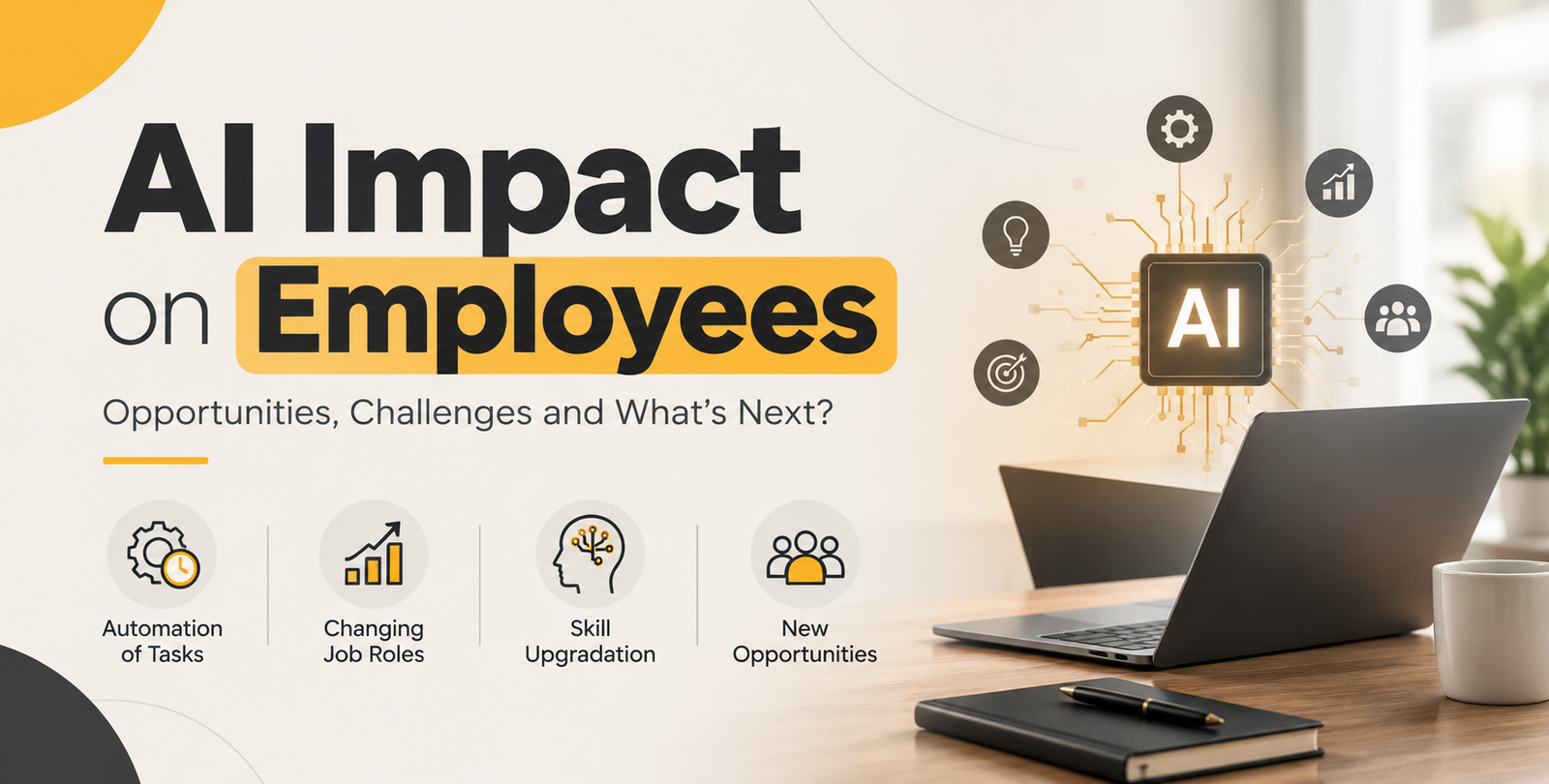
Artificial Intelligence (AI) is transforming the modern workplace faster than many people expected. From automating repetitive tasks to improving business decisions, AI-powered tools are helping companies become more productive, efficient, and competitive. Technology leaders and CEOs are increasingly adopting AI to manage operations, reduce costs, improve customer experiences, and accelerate business growth. Businesses are also exploring AI-powered automation and intelligent agents to streamline their operations. However, an important question deserves attention: Is AI making life easier for tech CEOs while making working life more difficult for everyday employees?
The growing adoption of AI has created new opportunities for businesses, but its benefits are not always distributed equally. While company executives can use AI to make faster decisions and increase profits, employees may face concerns about job security, workplace monitoring, changing responsibilities, and the need to learn new skills. This raises an important issue about the AI impact on employees and whether the future of work will benefit everyone or primarily those who control the technology.
The growing AI impact on employees is becoming an important topic as businesses continue adopting automation and intelligent technologies.
How AI Is Making Life Easier for Tech CEOs
For technology CEOs, AI has become a powerful business tool. Running a company involves making decisions, managing teams, understanding market trends, monitoring financial performance, and maintaining customer relationships. AI can simplify many of these responsibilities.
AI-powered analytics tools can process large amounts of business data and identify patterns that might otherwise take employees several hours or days to discover. CEOs can use these insights to understand customer behaviour, predict market demand, improve business strategies, and identify potential risks.
Automation is another major advantage. Tasks such as preparing reports, managing customer enquiries, organising documents, and analysing performance data can increasingly be supported by AI systems. This allows executives to spend more time on business expansion, innovation, partnerships, and long-term planning.
AI agents are also changing how businesses manage complex operations. Companies are increasingly exploring autonomous systems that can perform multiple tasks with limited human intervention. These technologies help organisations streamline workflows, reduce repetitive tasks, improve efficiency, and make faster business decisions.
Generative AI tools also help leaders prepare presentations, summarise lengthy documents, generate ideas, and communicate more efficiently. As a result, AI is becoming an important assistant for business leaders who want to improve productivity without increasing their workload.
While these advancements offer significant advantages to business leaders, the AI impact on employees also deserves attention because workplace automation affects people at every level of an organisation.
However, these advantages raise a bigger question: if executives are saving time and money through AI, are employees receiving the same benefits?
The Growing AI Impact on Employees
While AI offers significant business opportunities, its impact on everyday employees is more complicated. Workers across industries are experiencing changes in the way they perform their jobs.
Administrative assistants, customer support representatives, content creators, data entry professionals, junior analysts, and other employees who perform repetitive digital tasks may see parts of their responsibilities automated.
For example, a customer support department that previously required a large team may now use AI chatbots to answer common questions. Similarly, AI writing assistants can help marketing departments produce content faster, while automated data tools can reduce the time required for routine reporting.
This does not automatically mean that all these jobs will disappear. In many cases, AI changes job responsibilities rather than eliminating entire occupations. However, employees may still face uncertainty about future opportunities, salary growth, workload, and career development.
The challenge is not simply whether AI can perform a task. It is whether companies will use the technology to support employees or replace them wherever possible.
Understanding the AI impact on employees can help workers prepare for changing job responsibilities and new workplace expectations.
Why AI Benefits May Not Be Shared Equally
One of the biggest concerns surrounding workplace AI is the unequal distribution of its benefits.
CEOs and senior executives often have greater access to advanced technology, specialist teams, training resources, and the authority to decide how AI is implemented. Everyday employees may have little control over these decisions, even when the technology directly affects their responsibilities.
Consider a company that introduces AI-powered automation to reduce operational expenses. Management may benefit from lower costs, faster processes, and improved productivity. Employees, however, may experience increased performance expectations, reduced working hours, fewer opportunities, or additional responsibilities.
In some workplaces, AI tools are also used to monitor productivity, analyse employee performance, and track working patterns. Although these systems can help organisations identify inefficiencies, excessive monitoring may reduce employee privacy, independence, and job satisfaction.
Research on workplace AI also highlights the importance of balancing productivity opportunities with employee rights and working conditions. Studies show that businesses must consider employee wellbeing, workplace safety, privacy, and fair working conditions when introducing AI technologies.
Understanding the AI impact on employees is essential for creating fair workplace policies and ensuring that technological progress benefits everyone.
The problem is not AI itself. The real concern is how businesses choose to distribute the advantages and responsibilities associated with this technology.
Will AI Replace Everyday Employees?
The possibility of job displacement is one of the most discussed concerns about artificial intelligence.
AI systems are becoming increasingly capable of handling tasks involving writing, research, customer communication, data analysis, scheduling, and basic problem-solving. This creates pressure on occupations that depend heavily on predictable and repetitive activities.
However, it is important to understand the difference between automating a task and replacing an entire job.
Most occupations involve multiple responsibilities, including communication, creativity, decision-making, teamwork, emotional understanding, and practical problem-solving. AI may perform some of these activities, but human involvement remains important in many situations.
According to the International Labour Organization’s 2025 research report, Generative AI and Jobs: A 2025 Update, approximately one in four workers worldwide are in occupations with some degree of exposure to generative AI. The research also suggests that most jobs are more likely to be transformed than completely eliminated.
This means employees should focus on adapting to technological changes rather than assuming that every AI development will result in job losses.
The AI impact on employees will largely depend on how businesses balance automation with human skills and employment opportunities.
The Workplace Skills Gap Is Becoming More Important
As companies introduce AI into everyday operations, employees need opportunities to develop new skills.
Digital literacy, critical thinking, communication, problem-solving, creativity, and the ability to work alongside AI tools are becoming increasingly valuable. Workers do not necessarily need to become AI engineers or professional programmers to remain relevant.
For example, a marketing employee can learn to use AI for research and content planning while focusing on brand strategy and creative direction. A customer support representative can use AI to find information faster while concentrating on complex customer problems that require human understanding.
However, AI systems can also create new security and workplace challenges. Businesses need to understand the risks associated with autonomous AI agents, data access, and automated decision-making. Our article on security risks of autonomous AI agents explores why organisations must take these issues seriously.
The responsibility for this transition should not fall entirely on employees.
Companies investing in AI should also invest in training programmes, practical workshops, and opportunities for workers to develop relevant skills. Without these opportunities, AI adoption could create a divide between employees who can benefit from new technology and those who struggle to keep up.
Can AI Improve Employee Productivity Instead of Replacing Workers?
AI does not have to become a threat to everyday employees. When implemented responsibly, it can make working life easier for people at different levels of an organisation.
Employees can use AI to reduce repetitive work, organise schedules, prepare documents, analyse information, and complete routine tasks more efficiently. This can create additional time for creative thinking, collaboration, customer relationships, and professional development.
For example, an employee who previously spent several hours preparing a report might use AI to organise information and create an initial draft. The employee can then focus on checking accuracy, interpreting results, and presenting useful recommendations.
Similarly, software developers can use AI coding assistants to speed up development while maintaining human oversight, code reviews, and security checks. Read more about this changing development process in our article on AI-generated software and production readiness.
This approach makes AI a productivity partner rather than a direct replacement for human workers.
The real opportunity is to create workplaces where AI handles repetitive activities while employees contribute their experience, judgement, creativity, and interpersonal skills.
A positive AI impact on employees is possible when companies use intelligent tools to support workers rather than simply reduce their workforce.
What Tech Companies Should Do to Protect Everyday Employees
Technology companies have an important responsibility to ensure that AI adoption benefits more than just senior management and shareholders.
1. Introduce AI transparently: Employees should understand which tools are being introduced, how these systems will affect their responsibilities, and whether performance evaluations or workplace monitoring will change.
2. Provide accessible AI training: Employees should have opportunities to learn how to use new tools during working hours instead of being expected to develop every new skill independently.
3. Support internal job transitions: Workers whose responsibilities are affected by automation may be able to move into other roles with suitable training and support.
4. Protect employee privacy: Businesses should establish clear rules about how AI systems collect, process, and use employee information.
5. Share productivity benefits fairly: Companies should measure AI success through more than financial savings. Employee satisfaction, workplace safety, career development, productivity, and fair compensation should also be considered.
A business that increases profits through AI but ignores employee wellbeing may achieve short-term savings while creating long-term problems with trust, motivation, and workforce stability.
The Future of AI: A Better Workplace for Everyone?
The future of artificial intelligence will depend on the decisions businesses make today. AI can help CEOs become more efficient, but it can also help employees become more productive, creative, and confident in their work.
The important question is whether organisations will treat AI as a tool for shared progress or simply as a way to reduce labour costs.
A balanced approach requires cooperation between business leaders, employees, technology developers, and policymakers. Companies must ensure that workers have access to AI tools, relevant training, fair working conditions, and a meaningful role in decisions that affect their careers.
The next stage of workplace transformation should not be measured only by how much money AI saves companies. It should also be measured by how much it improves the lives of the people working within them.
Final Thoughts
AI is creating a new business environment in which technology leaders can make faster decisions, automate operations, and improve productivity. However, the AI impact on employees must receive equal attention.
Everyday workers should not become the forgotten part of the AI revolution. They deserve access to the same technological opportunities, proper training, career development, and protection from unfair workplace practices.
The long-term AI impact on employees should be measured by improved working conditions, better career opportunities, and fair access to technology.
Ultimately, successful AI adoption should create value for both businesses and their employees. The goal should not be to build a future where CEOs enjoy all the advantages while workers carry all the risks. Instead, AI should help create a more productive, inclusive, and balanced workplace where everyone has an opportunity to benefit from technological progress.


Leave a Reply