
TL;DR
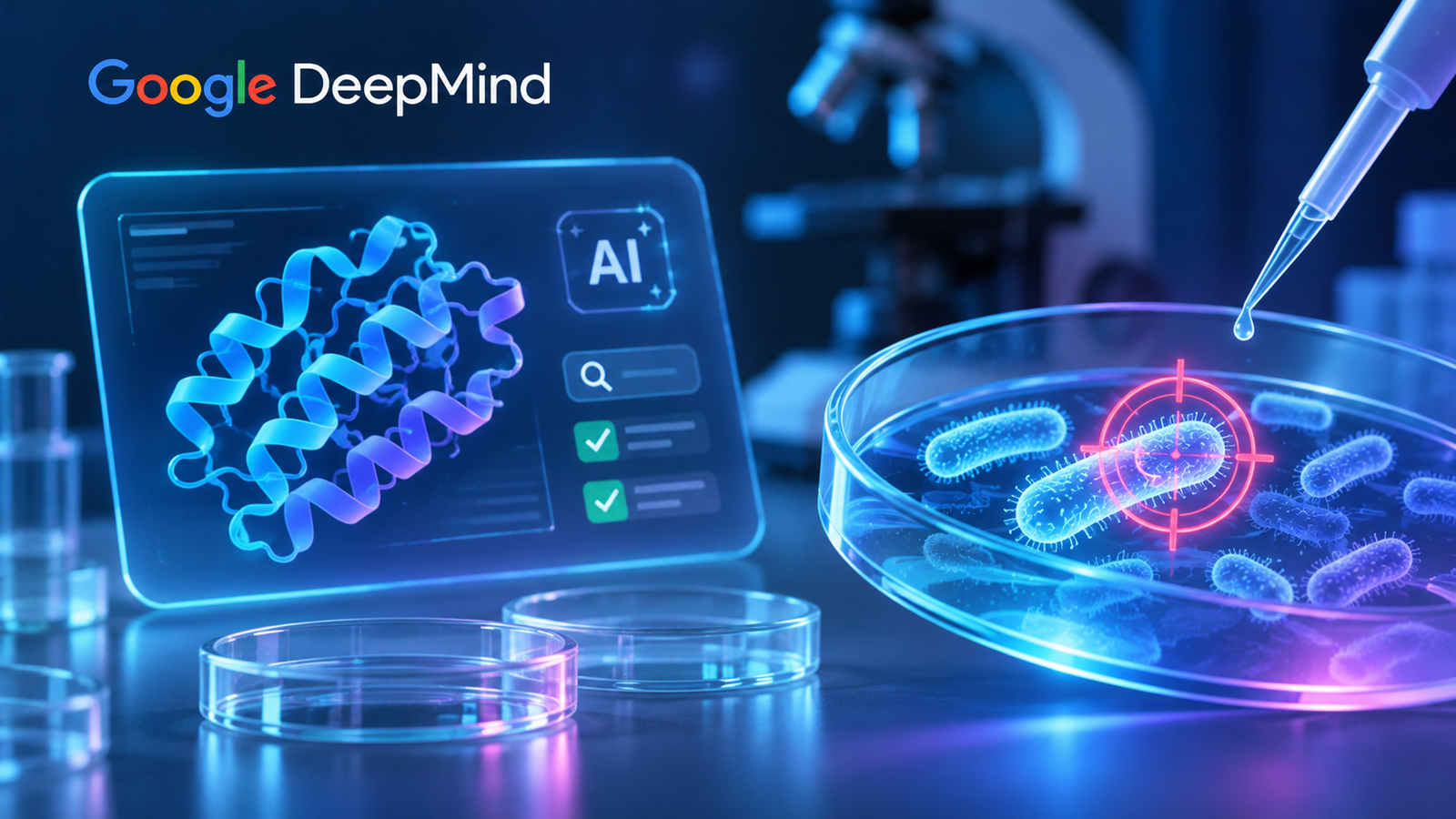
Google DeepMind is exploring how AI agents can accelerate the search for new antimicrobial treatments. Using Google Antigravity, the ProtNLM protein language model, and biological databases, researchers identified a potential antimicrobial peptide that may target bacteria associated with respiratory infections. The candidate is undergoing laboratory validation. The research demonstrates how AI could help scientists investigate previously uncharacterized proteins, although experimental testing remains essential before any candidate can be considered a viable treatment.
Antimicrobial resistance is becoming one of the most pressing challenges in modern healthcare. As bacteria evolve resistance to existing medicines, infections that were once relatively straightforward to treat can become increasingly difficult to manage.
Developing new antibiotics is a complex process involving extensive biological research, compound screening, laboratory experiments, and clinical testing. Researchers must examine enormous amounts of biological data to identify molecules that could become effective treatments.
Google DeepMind is exploring how artificial intelligence could make some of this early-stage research faster and more efficient.
In an update published on October 15, 2026, Google DeepMind described how researchers used its Google Antigravity agentic development platform to investigate previously uncharacterized proteins and identify a potential antimicrobial peptide. The workflow combines AI-assisted research, protein-function prediction, structural analysis, and scientific literature review.
The result is not a finished antibiotic. Instead, it offers an example of how AI agents could help researchers narrow down the enormous search space involved in discovering new treatments.
Read Google DeepMind’s official research update.
What Is Antimicrobial Resistance, and Why Does It Matter?
Antimicrobial resistance (AMR) occurs when microorganisms develop the ability to survive medicines designed to eliminate them or stop their growth.
The problem is particularly concerning when bacteria become resistant to multiple antibiotics. In these situations, clinicians may have fewer effective treatment options, and patients can require more complicated care.
According to the World Health Organization, bacterial antimicrobial resistance was directly responsible for an estimated 1.27 million deaths worldwide in 2019 and was associated with approximately 4.95 million deaths.
Resistance can emerge naturally through genetic changes and spread through the transmission of resistant microorganisms. However, inappropriate antimicrobial use, inadequate infection prevention, and limited access to effective treatments can worsen the problem.
The development of new antibiotics is one part of the response. Better diagnostics, infection prevention, responsible antimicrobial use, and public health surveillance are also essential.
AI could contribute by helping researchers discover and evaluate potential therapeutic molecules more efficiently.
How Google DeepMind Is Using AI to Search for New Antimicrobials
Google DeepMind’s approach brings several technologies together in a coordinated research workflow.
Rather than relying on a single model to suggest a molecule, researchers can use AI agents to query databases, analyze protein sequences, investigate predicted structures, review scientific literature, and organize evidence around potential candidates.
1. Google Antigravity Coordinates the Research Workflow
Google Antigravity is an agentic development platform that can coordinate complex tasks involving multiple tools and information sources.
In the antimicrobial discovery workflow, researchers establish the biological objective and guide the investigation. The AI agent then helps carry out data searches, compare evidence, examine molecular structures, and develop hypotheses.
This approach can reduce the time spent switching between separate databases and specialist applications.
For example, a researcher investigating a possible antimicrobial peptide may need to determine whether a protein has a known function, whether its structure resembles an established antimicrobial molecule, and whether nearby genes provide clues about its biological role.
An agentic workflow can help connect these steps within a more unified research environment.
The scientist remains responsible for evaluating the evidence, deciding which questions to investigate, and determining what requires experimental confirmation.
2. ProtNLM Helps Interpret Uncharacterized Proteins
A major challenge in biology is that sequencing technologies have generated enormous collections of protein sequences whose functions remain unknown or incompletely understood.
Google DeepMind’s Protein Natural Language Model, known as ProtNLM, is designed to predict protein functions from amino acid sequences.
Proteins are built from amino acids arranged in specific sequences. These sequences contain information that can provide clues about a protein’s structure and biological role.
ProtNLM applies machine learning to recognize patterns in protein sequences and generate functional annotations. These predictions can help researchers prioritize entries that deserve closer investigation.
The workflow uses UniProt, a major public resource for protein sequence and functional information, to investigate previously uncharacterized proteins.
This matters because a protein without an established functional annotation is not necessarily biologically unimportant. It may simply lack the experimental evidence or recognizable similarity needed for conventional annotation.
AI-based predictions can help scientists investigate this underexplored biological information.
However, a predicted function is a hypothesis, not definitive proof of what a protein does.
3. Structural Analysis Helps Evaluate Candidates
Protein sequences alone do not tell researchers everything they need to know. A protein’s three-dimensional structure can offer additional clues about its potential biological activity.
Google’s workflow incorporates structural analysis to examine promising candidates and compare their predicted structures with known proteins.
Researchers can use resources such as the AlphaFold Protein Structure Database to explore predicted protein structures.
Sequence comparisons and structural searches can then help establish whether a candidate resembles proteins with known biological functions.
These comparisons are valuable because proteins with limited sequence similarity can sometimes share structural features that provide clues about their function.
Nevertheless, structural similarity does not automatically demonstrate that two proteins perform the same function. Experimental evidence remains necessary to establish biological activity.
4. Genomic Context Provides Additional Evidence
Researchers can also investigate the genes surrounding a candidate protein’s coding sequence.
Nearby genes sometimes work together in related biological processes. Their functions and arrangement can therefore provide additional clues about the role of an uncharacterized protein.
In Google’s demonstrated workflow, the agent examined genomic context alongside sequence and structural evidence.
Combining these independent sources of information can make a candidate more compelling than relying on a single model prediction.
The objective is to build a stronger scientific hypothesis before committing resources to laboratory experiments.
What Did Google DeepMind’s AI Workflow Identify?
In its October 2026 research walkthrough, Google DeepMind described an investigation involving Streptococcus pseudopneumoniae, a bacterial species associated with respiratory tract infections.
The researchers used ProtNLM and Google Antigravity to search biological databases and investigate candidate proteins.
The workflow identified a previously uncharacterized protein candidate with features consistent with a bacteriocin, a type of antimicrobial peptide produced by bacteria.
The candidate was 97 amino acids long and belonged to the Lactococcin 972 family. Researchers then examined its sequence, predicted structure, genomic surroundings, and related scientific literature to assess whether the initial hypothesis was plausible.
The combined evidence supported further investigation, including laboratory testing.
However, the findings must be interpreted carefully.
The research does not establish that the candidate is an effective antibiotic in humans. Its predicted activity must be tested experimentally, and researchers must determine whether it can act against relevant pathogens without causing unacceptable harm to human cells.
Google DeepMind reported that the candidate, along with several other candidates identified through the workflow, was undergoing laboratory validation.
The significance lies in the discovery process: AI helped researchers narrow a large collection of biological sequences into a smaller group of candidates for further study.
How AI Agents Could Change Drug Discovery
The broader opportunity extends beyond antimicrobial peptides. AI-assisted research could help scientists explore biological data, formulate hypotheses, and prioritize experiments across multiple areas of drug discovery.
Searching Larger Biological Datasets
Modern biological databases contain vast numbers of protein sequences, genomic records, and molecular structures.
Examining these resources manually can be time-consuming, especially when researchers need to connect information across different databases.
AI systems can help identify patterns, retrieve relevant records, and prioritize candidates for expert review.
This does not eliminate the need for domain knowledge. Instead, it can help researchers focus their attention on the candidates and questions that appear most promising.
Reducing Early-Stage Research Bottlenecks
Drug discovery involves many stages, and some early tasks require substantial information gathering before a laboratory experiment can begin.
An AI agent may help consolidate database searches, compare molecular evidence, summarize research papers, and prepare an initial experimental plan.
Reducing this administrative and analytical workload could allow scientists to spend more time interpreting results and designing experiments.
The actual time savings will depend on the research question, data quality, available tools, and how much verification the workflow requires.
Connecting Different Scientific Tools
Biological research often involves specialized systems for protein annotation, sequence alignment, structure prediction, and literature analysis.
An agentic platform can help coordinate these tools within a connected workflow.
This is an important distinction between a conventional chatbot and a research-oriented AI agent. Rather than simply generating an explanation, an agent can help execute a sequence of related tasks and bring the resulting evidence together.
For more AI developments and emerging applications, visit AI News Today.
What Are the Limitations of AI-Powered Antibiotic Discovery?
Despite its potential, AI-assisted drug discovery faces significant scientific and practical challenges.
Predictions Can Be Wrong
AI models identify statistical patterns in data. Their predictions can be useful, but they can also be incomplete or incorrect.
A model may assign a plausible function to a protein without accurately predicting how it behaves in a living organism.
Independent evidence and experimental validation are therefore essential.
Laboratory Validation Is Still Necessary
A promising computational result is only an early step in drug development.
Researchers must establish whether a candidate has the expected antimicrobial activity, determine which organisms it affects, assess its toxicity, and investigate how it behaves under relevant biological conditions.
Further research may be required to understand its mechanism of action, stability, and potential to trigger resistance.
Even candidates that perform well in early laboratory experiments may fail during subsequent development.
Discovering a Molecule Is Not the Same as Developing a Medicine
A potential antimicrobial compound must pass through multiple stages before it can become an approved treatment.
Depending on the findings, development may involve additional laboratory studies, animal research, clinical trials, manufacturing development, and regulatory review.
AI may help researchers identify promising starting points, but it cannot bypass the evidence required to demonstrate safety and efficacy.
Access and Reproducibility Matter
The usefulness of AI-assisted research also depends on the quality of underlying data and the ability of independent researchers to evaluate its conclusions.
Transparent methods, reproducible analyses, well-documented experimental results, and collaboration between AI researchers and biological scientists will be important for establishing the reliability of these systems.
What Comes Next for Google’s AI-Assisted Research?
The immediate priority is to establish whether the antimicrobial candidates identified computationally demonstrate meaningful activity in laboratory tests.
Positive results would provide evidence that the workflow can identify useful biological leads. Negative results would also be informative, helping researchers understand where predictions fall short and how candidate selection could improve.
Further work will be needed to determine how consistently the approach performs across different organisms, protein families, and research objectives.
Google DeepMind’s demonstration also points toward a broader role for AI agents in scientific discovery. The same general approach of coordinating databases, models, specialist tools, and human expertise could be explored in other areas of biological research.
The most meaningful measure of progress will not be the number of candidates an AI system generates. It will be whether those candidates produce reproducible experimental results and contribute to better scientific outcomes.
Conclusion
Google DeepMind’s work illustrates how AI agents could help researchers tackle one of the most difficult stages of antimicrobial discovery: finding promising molecules within vast amounts of biological data.
By combining Google Antigravity, ProtNLM, protein databases, structural analysis, and scientific literature review, the team has demonstrated a workflow for identifying and prioritizing potential antimicrobial peptides.
The candidate identified in the research remains experimental, and its therapeutic value has not yet been established. Laboratory validation will determine whether the computational evidence translates into meaningful biological activity.
As antimicrobial resistance continues to challenge healthcare systems, AI-assisted research offers a promising way to investigate new possibilities. Its greatest contribution may be helping scientists explore more of biology, prioritize better experiments, and make more informed decisions about where to direct their research.
Follow AI News Today for more updates on artificial intelligence, AI agents, scientific discovery, and emerging technologies.


Leave a Reply