
TL;DR
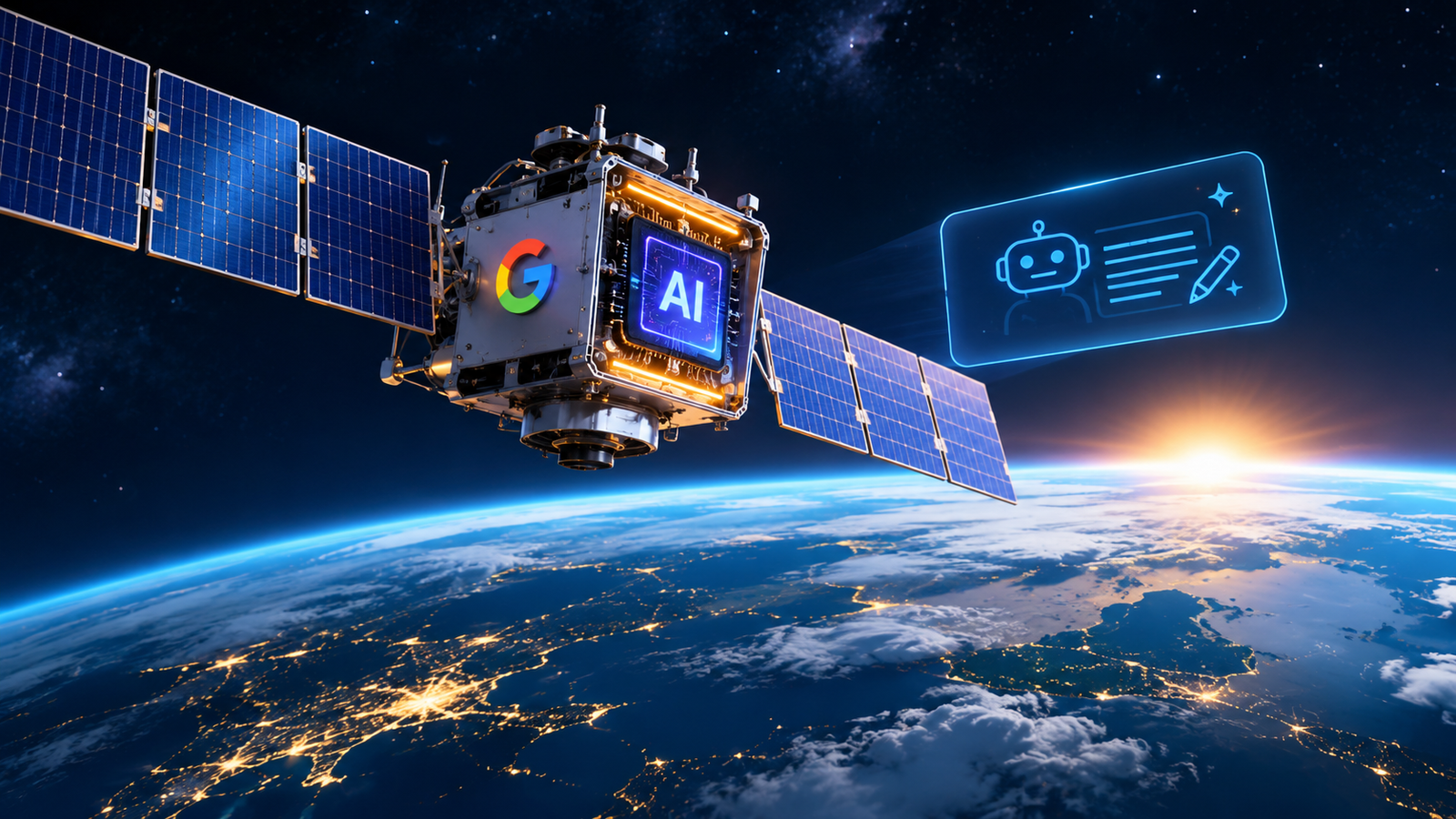
Google has received its first AI-generated response from a prototype satellite operating in orbit as part of Project Suncatcher. The satellite runs Google’s Gemma 4 model on Tensor Processing Units (TPUs), demonstrating that AI hardware can execute inference workloads in space. The experiment is an early step toward solar-powered orbital computing infrastructure, although radiation, thermal management, communications, launch costs, and reliability remain significant challenges.
Artificial intelligence infrastructure is moving beyond traditional data centers on Earth. Google has reached a new milestone in this direction after successfully running an AI model on a prototype satellite and receiving its first response from orbit.
The experiment is part of Project Suncatcher, Google’s long-term research initiative exploring whether solar-powered satellites could eventually support large-scale machine learning workloads in space.
The satellite has already completed an important demonstration: responding to a prompt with an AI-generated haiku about space. While the output itself is simple, the engineering achievement behind it is considerably more significant.
The test demonstrates that a data center-class AI processor can run an inference workload in orbit and return its output to Earth. It also provides Google with an opportunity to study how computing hardware performs under the environmental conditions of space.
Google shared the milestone in its official Project Suncatcher update on October 30, 2026.
What Is Google’s Project Suncatcher?
Project Suncatcher is a research initiative investigating how interconnected, solar-powered satellites could eventually become an alternative platform for AI computing.
Conventional AI infrastructure relies on terrestrial data centers filled with processors, networking equipment, cooling systems, and power infrastructure. As AI models become more capable and widely deployed, the industry faces growing challenges around electricity demand, cooling requirements, land availability, and the cost of expanding computing capacity.
Google is exploring whether some of these constraints could be addressed by placing computing hardware in orbit.
The proposed concept involves satellites equipped with Google’s Tensor Processing Units, or TPUs, connected through high-speed optical communication links. Rather than treating every satellite as an isolated computer, future systems could coordinate processing across multiple spacecraft.
The project remains experimental. Its current objective is to validate the technology required for orbital AI computing, not to replace existing data centers immediately.
Google first introduced the initiative in November 2025. Its initial research examined satellite constellation design, optical communications, solar power generation, and the effects of radiation on AI hardware.
Read Google’s Project Suncatcher research overview for more information about the proposed architecture.
How Did the AI Satellite Generate Its First Response?
The prototype satellite launched into orbit on October 1, 2026, through a rideshare mission developed with Planet Labs and SpaceX.
After launch, engineers spent several weeks commissioning the spacecraft and checking its onboard systems. The team then began running early machine learning tests on its AI hardware.
The milestone came when engineers sent a prompt to Google’s Gemma 4 model running onboard the satellite.
The model generated this haiku:
Blue marble below
Data streams in silent grace
Starlight feeds my core.
The response was transmitted back to Earth during a ground-station communication window as the satellite passed over the region of Svalbard, Norway.
The team also tested other space-themed writing prompts and requested telemetry information about the spacecraft’s operating conditions.
The experiment is important because it demonstrates an end-to-end process: sending a command to an orbital computer, executing an AI inference task, and receiving the completed response on Earth.
However, the satellite is not yet a fully operational commercial data center. It is a prototype designed to help engineers understand whether the underlying hardware and supporting systems can work reliably in orbit.
What Technology Powers Google’s Space-Based AI Experiment?
Several technologies must work together to make orbital computing possible.
1. Tensor Processing Units
Google’s TPUs are specialized processors designed to accelerate machine learning workloads. They perform the computational operations required by AI models, including the inference tasks used to generate text and analyze information.
The prototype carries four TPUs, but Google clarified that only one can operate at a time because of the satellite’s power limitations.
This is a critical distinction. Although the spacecraft carries multiple processors, it cannot yet run them all simultaneously at full capacity.
The current experiment focuses on validating hardware operation and gathering data that can guide future designs.
2. Gemma 4 AI Model
The satellite runs Google’s Gemma 4 open model to process prompts and generate responses.
Running an AI model directly in orbit allows the team to test computing workloads under real space conditions rather than relying entirely on laboratory simulations.
This is an example of edge AI computing, where data is processed close to its source instead of being sent to a distant centralized system.
For more context on how AI systems can divide tasks across computing resources, read our guide to AI agent swarms and distributed business automation.
3. Solar Power Generation
One of the central ideas behind Project Suncatcher is that satellites in carefully selected orbits can access abundant sunlight.
According to Google’s earlier research, solar panels in suitable low Earth orbits could generate up to eight times more energy than comparable panels on Earth under the conditions considered in its analysis.
Near-continuous sunlight could reduce dependence on large onboard batteries and provide a potential energy advantage for future computing systems.
However, generating electricity is only part of the challenge. The spacecraft must also distribute that power between processors, communications equipment, and other onboard systems.
4. Optical Satellite Communications
A future orbital computing network would need to transfer large volumes of data between satellites.
Google’s proposed architecture uses free-space optical links, which transmit information using light rather than relying exclusively on conventional radio-frequency communications.
High-speed links could allow nearby satellites to coordinate computing tasks and operate more like components of a distributed system.
The challenge is precision. Satellites move continuously, and maintaining high-bandwidth connections between closely positioned spacecraft requires sophisticated tracking, positioning, and communication technology.
Why Does Google Want to Put AI Data Centers in Space?
The motivation extends beyond the novelty of running a language model in orbit.
Addressing AI’s Growing Energy Requirements
Training and operating AI models require substantial computing resources. As organizations deploy AI assistants, autonomous agents, generative applications, and predictive systems, demand for computing capacity continues to expand.
Terrestrial data centers require electricity infrastructure, cooling systems, land, and network connectivity. Space-based infrastructure could offer a different approach to supplying energy and computing capacity.
Solar-powered satellites may eventually reduce some dependence on terrestrial energy resources, although launch, maintenance, hardware, and communication costs must be included in any realistic economic comparison.
Exploring New Infrastructure Architectures
Traditional data centers concentrate computing resources within buildings. Project Suncatcher explores a distributed architecture in which multiple satellites could cooperate on computational workloads.
This concept has similarities to distributed computing on Earth, where workloads are divided among interconnected machines.
The difference is that orbital systems must also account for satellite motion, radiation exposure, limited power budgets, communication delays, and the difficulty of repairing hardware.
Processing Data Closer to Its Source
Orbital computing could also be useful for processing data collected by satellites.
Earth-observation spacecraft, for example, generate imagery and other sensor data that may need to be transmitted to ground infrastructure for analysis. Processing selected information in orbit could eventually reduce the need to transmit every raw data point.
Potential applications include satellite imagery analysis, environmental monitoring, disaster assessment, and other space-based sensing operations.
These are possible future applications, not capabilities established by Google’s current poetry demonstration.
The Biggest Challenges Facing Space-Based Data Centers
Despite the successful test, several engineering problems remain before orbital AI infrastructure could operate at a meaningful commercial scale.
Radiation Can Affect AI Hardware
Earth’s atmosphere and magnetic environment provide protection from much of the radiation encountered in space. Satellites must operate in a harsher environment where energetic particles can interfere with electronic components.
Radiation-induced errors, including memory bit flips, can corrupt computations or stored data.
Google’s next tests will examine how its TPUs behave under actual orbital radiation exposure and whether observed errors affect AI workloads.
Cooling Processors in a Vacuum
AI accelerators generate heat when they operate. Terrestrial data centers typically use air or liquid cooling systems to remove that heat.
Space presents a different problem because a vacuum does not support ordinary convective cooling. Heat must instead be managed through mechanisms such as thermal conduction, heat pipes, and radiators that release energy as thermal radiation.
A practical orbital data center would need to manage processor temperatures while minimizing the mass, power consumption, and complexity of its cooling system.
Limited Power Availability
The prototype’s power budget restricts how many TPUs it can operate simultaneously.
Larger AI workloads will require more electricity, efficient power distribution, and better integration between solar arrays, processors, and thermal management systems.
Scaling up computing capacity will require solving these constraints together rather than simply adding more chips.
Launch and Replacement Costs
Every satellite must be manufactured, tested, and launched. Hardware failures could be expensive to address because repairs and replacements in orbit are difficult.
Even if solar energy is abundant, the overall system may remain more expensive than terrestrial infrastructure until launch costs, manufacturing processes, satellite lifetimes, and operating models improve.
For comparison, Google’s conventional data center strategy continues to involve investments in energy supply and grid infrastructure. Its data center and clean-energy initiatives illustrate the scale of coordination required to support computing demand on Earth.
What Happens Next for Project Suncatcher?
Google’s next milestone is expected to involve two interconnected satellites in 2027.
The planned demonstration will explore optical links between spacecraft and help the team evaluate the foundations of a distributed orbital computing system.
Further testing will examine processor reliability, thermal behavior, radiation exposure, and the ability to execute machine learning workloads under real operating conditions.
The results will help determine whether the technology can progress from a single-satellite experiment toward a coordinated network.
Google has described Project Suncatcher as a long-term research effort. Any large-scale deployment would require additional advances in satellite manufacturing, launch economics, power systems, thermal engineering, and communication technology.
The timeline for commercially competitive orbital data centers remains uncertain.
How Could Space-Based AI Change the Future of Computing?
Project Suncatcher highlights a broader shift in AI infrastructure research. Instead of relying exclusively on larger buildings and more powerful terrestrial systems, technology companies are investigating new locations and architectures for computing.
This shift is happening alongside advances in AI agents, specialized processors, edge computing, and distributed systems.
Our coverage of AI agent swarms examines how multiple AI components can collaborate to complete complex tasks. Meanwhile, our article on AI agent security threats explores the risks that arise as AI systems gain more autonomy and access to critical resources.
Orbital computing introduces another layer of complexity. A future satellite network would need not only to execute AI workloads efficiently but also to maintain secure communications, verify computational results, manage failures, and protect data moving between spacecraft and ground systems.
For businesses, the immediate takeaway is not that AI infrastructure will soon move into space. It is that the systems supporting AI are evolving rapidly, with energy efficiency, specialized hardware, distributed processing, and reliability becoming increasingly important.
Conclusion
Google’s first successful AI response from orbit is a small output with significant engineering implications.
The Project Suncatcher prototype has demonstrated that a satellite carrying Google TPUs can run Gemma 4 and transmit a completed response to Earth. The achievement provides an early foundation for studying whether interconnected, solar-powered satellites could support future AI computing workloads.
Much remains unproven. Radiation, thermal management, limited power, optical networking, and launch economics will determine whether the concept can move beyond experimental missions.
For now, Google’s space-based AI initiative is best understood as an early infrastructure experiment rather than a replacement for terrestrial data centers. Its progress will offer valuable insights into how far machine learning systems can extend beyond the computing environments used today.
Follow AI News Today for more updates on AI infrastructure, emerging models, autonomous agents, and the technologies shaping the future of artificial intelligence.









Leave a Reply